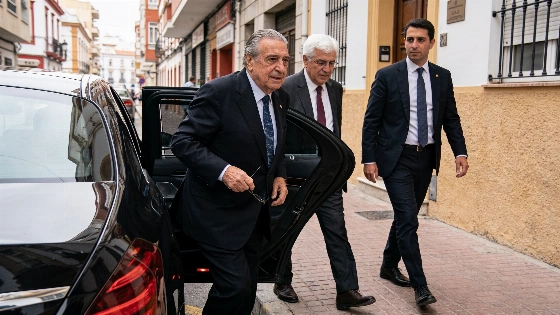
Florentino Pérez is traveling to Ceuta just days after Real Madrid players declined to fully display shirts supporting the city. The visit comes as the club faces questions about its relationship with Ceuta and its response to the recent controversy.
Three days after a public dispute over Real Madrid’s show of support for Ceuta, club president Florentino Pérez will arrive in the city on Friday morning. The visit follows an incident in Elche, where players Mbappé, Vinicius, and Konaté declined to fully display shirts backing the autonomous city, sparking debate about the club’s internal unity and its ties to Ceuta.
Pérez will be joined by Pirri, the club’s honorary president and a native of Ceuta, as well as Emilio Butragueño, Real Madrid’s director of institutional relations. Their presence is seen as an effort to reinforce the club’s connection to Ceuta at a time when that relationship is under scrutiny.
The incident occurred before the Elche–Real Madrid match on Tuesday, when Mbappé, Vinicius Jr., and Ibrahima Konaté partially concealed or did not fully wear shirts bearing the message 'Todos somos caballas' ('We are all caballas', referring to Ceuta residents).
The controversy began on Tuesday, when several high-profile players refused to take part in the symbolic gesture, drawing immediate attention. The incident, first reported by Okdiario and confirmed by this publication, has put Real Madrid’s leadership in the spotlight and raised questions about the club’s approach to regional issues and the willingness of its stars to follow official messaging. According to Al Jazeera, the episode provoked a strong reaction from fans, with one Real Madrid supporter group demanding public apologies from Mbappé and his teammates.
Ceuta has been in the national conversation in recent weeks. As reported earlier, local leaders have used national platforms to highlight the city’s challenges and the importance of visible support from major institutions. Against this backdrop, the actions of Real Madrid’s players—and the club’s response—have drawn extra attention. International media, including France 24, have linked the solidarity gesture and the controversy to the ongoing migration crisis in Ceuta and the wider debate over the city’s status and support.
By sending its top leadership to Ceuta, Real Madrid is aiming to reaffirm its public commitment to the city and address any perception of division within the club. The inclusion of Pirri, who is from Ceuta, adds a personal element to the visit. While the club has not issued a formal statement on the players’ refusal, the decision to organize this high-profile trip so soon after the incident suggests a move to restore confidence and show unity.
La Liga president Javier Tebas clarified that the shirt solidarity action was approved but not organized by the league, and emphasized it was not a political act. Some sources note that Real Madrid as an institution has supported the players' right to express their opinions, rather than distancing itself from them.
This episode shows how even symbolic gestures can become flashpoints for bigger questions about identity, loyalty, and representation in Spanish football. Real Madrid’s leadership, by acting quickly and visibly, is making it clear that the club’s relationship with Ceuta is a priority. In a climate where every action is scrutinized, responding decisively to internal and external pressures remains a test for any major institution. Real Madrid is signaling it intends to meet that challenge.