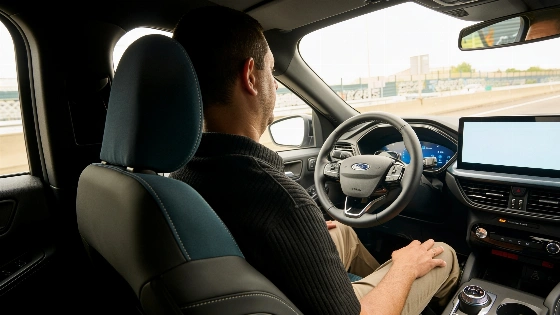
Ford’s BlueCruise now lets drivers take their hands off the wheel on Spain’s highways. The system covers most major routes, but drivers must stay alert and ready to take control at any moment.
On Spanish highways this week, Ford’s BlueCruise system quietly started taking over the wheel. Drivers in Kuga, Puma, Puma Gen-E, Mustang Mach-E, and Ranger plug-in hybrid models can now let the car handle steering and speed on certified stretches, as long as they keep their eyes on the road.
BlueCruise doesn’t let anyone zone out. The system manages acceleration and lane position only in pre-approved BlueZones, but a camera behind the wheel tracks the driver’s gaze. Lose focus, and the car sounds an alert. Ford and the DGT both stress that BlueCruise is a support tool, not a replacement for human judgment. The driver must be ready to step in at any second.
BlueCruise operates only within pre-mapped Blue Zones; if the vehicle leaves these certified sections, hands-free mode is automatically disabled, though basic driver assistance features may continue to function.
Getting BlueCruise running takes a few steps. The driver taps through the multimedia system to Driver Assistance, selects Cruise Control, then enables Lane Centering with Hands-Free. A steering wheel icon lights up on the dash, but only inside a BlueZone. Ford claims over 90% of Spain’s high-speed roads now qualify, so most long trips are covered. The Spanish launch is part of a wider European push. BlueCruise now runs in Portugal and France, as well as Germany, Italy, the Netherlands, Belgium, Denmark, Norway, Austria, Poland, Sweden, Czechia, and Hungary. Across these 16 countries, Ford says Blue Zones cover about 95% of the motorway network.
Eligible vehicles get a 90-day free trial. After that, BlueCruise costs 24.99 euros per month or 280 euros per year. Ford has also rolled out BlueCruise Edition versions of the Puma, Puma Gen-E, and Kuga, marked by black wheels and a Vapour Blue paint job. In some countries, these editions come with BlueCruise pre-installed and no extra subscription, showing how the offer shifts by market.
For anyone eyeing hands-free tech, the boundaries are clear. BlueCruise handles curves and speed, but the driver must watch traffic and react to hazards. This mirrors the slow, careful rollout of advanced driver assistance in other regions, where regulators demand a tight leash on automation. Under European Union Regulation 2019/2144, every new car sold in the EU from 2024 must include advanced driver assistance systems such as intelligent speed adaptation and emergency braking, plus drowsiness detection and event data recorders. That sets the stage for systems like BlueCruise.
In Spain, the DGT emphasizes that distracted driving—such as using a phone, adjusting vehicle systems, or interacting with passengers—remains strictly prohibited, even when using hands-free assistance. Violations can result in a 200-euro fine and a loss of 6 license points.
Spain’s car market has already seen a surge in electrification and automation. Recent moves by Spanish tech firms in the global EV sector show the country’s appetite for new mobility. BlueCruise’s arrival signals that mainstream brands are ready to push automation further, but without letting drivers off the hook.
Ford’s approach is blunt: BlueCruise cuts driver workload on long trips, but never lets the person behind the wheel become a bystander. As more vehicles adopt similar systems, Spanish drivers will face new routines on the highway. For now, BlueCruise puts more of the work on the car, but the driver’s vigilance still calls the shots.