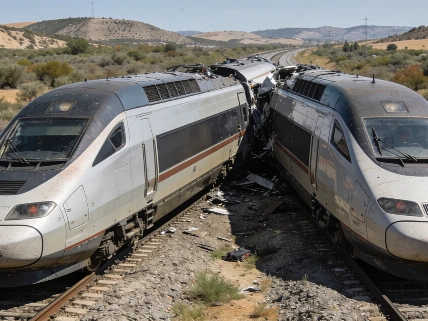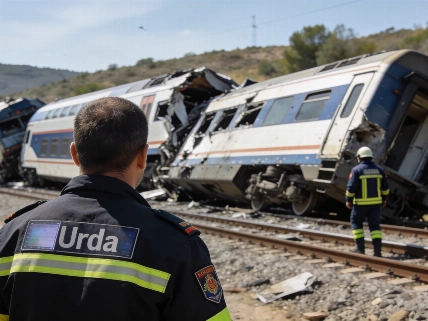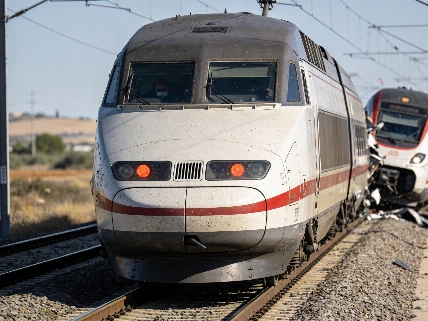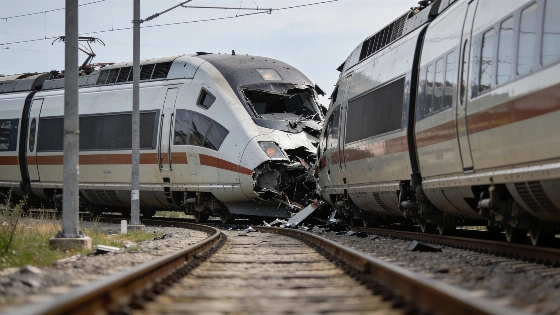
A call from Atocha control came 17 minutes before the collision at Urda. At about 08:53 on 28 October 2026, Renfe AVE service 02080 struck the rear of stationary Iryo service 6076 on the Madrid-Córdoba high-speed line, between Los Yébenes and Urda in Toledo province, about 120 kilometres south of Madrid. The AVE carried 396 passengers; the Iryo had 147 people aboard, including a baby. The trains were identified as a Siemens Mobility Velaro set and a Hitachi-built ETR1000. The account says no human or technical system alerted the crew to the obstruction.
Preliminary reporting attributed the sequence to an outage affecting the LZB train-protection system at about 08:30. The system continuously supervises train movement and speed, and its fail-safe response stopped trains in the area. At about 08:36, Adif control authorized the AVE to resume at normal speed, although the Iryo remained stopped ahead. Audio published by El Correo reportedly captured the instruction as “Reanude con marcha normal” (“Resume with normal running speed”). The Renfe train was travelling at more than 100 km/h when it hit the Iryo; two Iryo coaches reportedly derailed down an embankment. Later accounts put the toll at 69 dead and more than 100 injured.
Antonio Acedo Meneses was the train’s principal driver. Daniel Muñoz Cob, 31, was in the cab as a trainee, five years younger than his colleague. In their final exchange with control, Antonio asked whether they were being told to continue at normal speed. The answer was yes. Spain’s transport minister, Óscar Puente, said the train should not have been told to move again while a stop signal remained active. Investigations examined the LZB failure and communications between the drivers and Adif’s control centre, along with train movements.
Both men had built their lives around railways. Antonio, who was 36, grew up in Móstoles and spent much of his life in Loranca, a working-class district of Fuenlabrada. His father, José Antonio, was a retired train driver with a longstanding passion for railways. Antonio shared that passion, while also pursuing photography: his public Социальная сеть showed stations and anonymous passengers captured on his phone and analogue cameras.
Barcelona held a particular place in his life. He had lived there and described its pull in personal videos. Shortly before the crash, he told close friends he wanted to settle in Madrid and begin a new life with his partner. The link between railway work and personal vocation also recalls a profile of Gabriel Celaya, whose life joined engineering with poetry.
Antonio had also raised concerns about rail infrastructure. His friend Paula Fraga said he had spoken about the deterioration of tracks and his worries over safety. She believed his death could have been prevented. Antonio had helped prepare much of Izquierda Española’s transport programme, identifying shortcomings in the system.
Daniel’s route to the AVE took years. After working in maintenance at Thyssenkrupp and Btren, he moved to Suez. He began training as a train driver in 2019 and spent two years driving Rodalies services in Catalonia from 2021. Back in Madrid, he drove commuter trains for three years and three months before joining the AVE as a trainee in March.
Colleagues remembered Daniel as generous with new staff and always ready to help. He had studied electrical vocational training, then advanced robotics at the Salesians of Atocha. His former teacher Raúl said Daniel often returned to speak with students about his experience and encourage them.
After learning of the crash, Raúl sent Daniel a message asking how such an accident could have happened. Daniel did not reply. His former teacher then feared the worst.