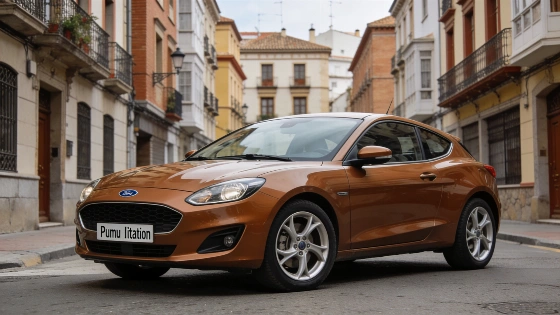
Ford has slashed the price of its top-selling Puma Titanium in Spain. The new offer packs in modern features and mild hybrid tech, making the compact SUV a stronger contender in a crowded market.
Spanish drivers looking for a compact SUV with real features just got a new option. Ford has dropped the price of its Puma Titanium to 23,805 euros. That’s for a model loaded with mild hybrid tech and a full set of comfort extras.
Most entry-level cars cut corners. Not here. The Puma Titanium comes with 17-inch alloy wheels, climate control, keyless start, privacy glass, a rearview camera, and rear parking sensors. City driving gets easier. Daily life gets more comfortable.
The Ford Puma Titanium is equipped with a 1.0-liter three-cylinder EcoBoost MHEV engine producing 125 hp, not a 1.5-liter engine as sometimes reported.
Tech takes center stage inside. The dashboard features a 12-inch touchscreen with SYNC 4 and a 12.8-inch digital instrument cluster. Navigation is connected. There are six speakers, two USB ports, and a built-in 5G modem. Safety isn’t an afterthought. Pre-collision assist, post-impact braking, lane keeping, fatigue detection, and automatic high-beam LED headlights all come standard.
Space is another reason the Puma leads Ford’s sales in Spain. In 2025, 10,619 units sold. The car measures 4.23 meters long, so it’s easy to park. The boot holds 456 liters. Drop the seats and use the Megabox under the floor, and you get up to 1,216 liters. Few rivals match that. Renting Finders confirms the 456-liter boot matches official specs.
Under the hood, the base engine is a 1.5 EcoBoost with 125 horsepower and 210 Nm of torque. It’s paired with a six-speed manual and mild hybrid (MHEV) tech. The car gets the DGT’s ECO badge. That means lower emissions and possible city perks. Top speed is 191 km/h. It does 0 to 100 km/h in 9.8 seconds. Claimed fuel use is 5.4 liters per 100 kilometers. That fits most Spanish families.
Despite the focus on hybrid technology, it is important to note that the Ford Puma uses a mild hybrid (MHEV) system, where the gasoline engine is assisted by an electric motor for improved efficiency and energy recuperation, but it is not a full self-charging hybrid.
Ford’s new price and long list of features put heat on rivals. The Volkswagen T-Roc, Kia Stonic, and Toyota Yaris Cross all face pressure. The Puma’s mix of design, tech, and space is tough to beat. Buyers now expect more for their money.
Other brands have tried to shake up Spain’s car market. Geely, for example, launched its E2 electric model with a bold value pitch, as reported earlier. Ford takes a different path. Instead of going all-in on electric, it bets on hybrid practicality and proven appeal.
By selling a well-equipped, electrified SUV for less than many competitors, Ford shows it knows what Spanish drivers want. Real features. Real savings. No trade-offs on daily use. This approach should keep the Puma at the top of Ford’s sales. Rivals may have to rethink their own offers in this crowded segment.