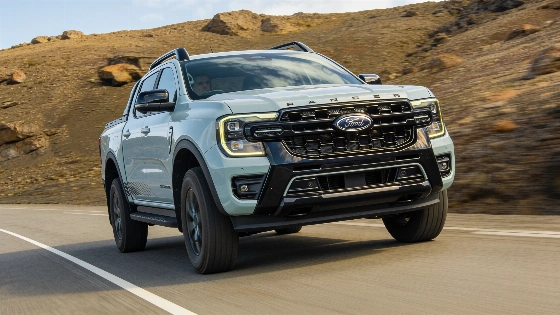
The Ford Ranger PHEV debuts as Europe’s first plug-in hybrid pick-up, blending a 281 hp powertrain with a one-tonne payload and 3,500 kg towing. Its electric range and 0-emission label open new options for both work and city driving.
Ford has launched the Ranger PHEV in Europe, marking a significant shift for the pick-up segment. This new model stands out as the first plug-in hybrid pick-up available on the continent, offering a blend of robust performance and practical electrification that aims to meet the demands of both commercial users and private owners.
The Ranger PHEV is powered by a 2.3-litre EcoBoost petrol engine paired with a 102 hp electric motor, integrated into a 10-speed automatic transmission. Together, they deliver a combined output of 281 hp and an impressive 697 Nm of torque—the highest ever for a production Ranger, excluding special racing editions. Despite its substantial weight of 2,586 kg, the vehicle accelerates confidently, aided by a transmission that allows manual gear selection, though the button-based shifting may feel less intuitive to some drivers.
The Ranger PHEV is the first plug-in hybrid pick-up to reach European roads, pairing genuine off-road capability with zero-emission city access.
Practicality remains central to the Ranger PHEV’s appeal. It can carry up to one tonne in the bed and tow up to 3,500 kg, matching the expectations for a workhorse in this class. However, the manually installed tow hitch is notably heavy, especially when compared to electrically operated systems found in some smaller vehicles. The hybrid system’s strong low-end torque and regenerative braking also enhance control during descents with heavy loads.
Off-road capability is another key strength. The Ranger PHEV features a transfer case and electronic rear differential lock, with selectable drive modes including 4x2, 4x4, 4x4 Low, and a range of terrain-specific settings such as Normal, Eco, Sport, Tow, Heavy Load, Slippery, Mud/Ruts, and Sand. This setup allows the vehicle to tackle challenging terrain, ford streams, and handle bridge crossings with confidence.
Inside, the Ranger PHEV introduces subtle design updates, including a body-coloured side badge, dual fuel flaps for petrol and electric charging, and new alloy wheels. The cabin is dominated by a striking 12-inch vertical touchscreen—an unusual feature for a vehicle with commercial roots, but one that brings the Ranger in line with modern expectations for connectivity and control.
One of the Ranger PHEV’s most relevant features for European cities is its DGT “0 Emissions” label, which grants access to low-emission zones (ZBE) that are increasingly common in urban areas. This makes the pick-up a rare option for those needing both heavy-duty capability and unrestricted city access, though its 5,370 mm length may pose challenges in tight spaces.
On the road, the Ranger PHEV offers a comfortable ride, with a suspension setup—double wishbones with coil springs at the front and leaf springs with external dampers at the rear—designed to balance load-carrying with everyday usability. The steering, requiring three full turns lock-to-lock, is less direct and more heavily assisted than some might prefer, but remains manageable in most scenarios.
The Stormtrak trim tested starts at €44,510 before discounts or government incentives, and comes well-equipped with features such as climate control, Matrix LED headlights, and a heated windscreen. This positions the Ranger PHEV as a compelling alternative for those seeking versatility without sacrificing comfort or technology.
The arrival of the Ranger PHEV reflects a broader trend in the European automotive market, where electrified pick-ups are beginning to find their place. For comparison, the recent update of the Renault 5 E-Tech, which now offers more power and range, highlights how manufacturers are adapting classic models to new regulations and consumer expectations. The Renault 5’s evolution underscores the growing importance of electrification across all vehicle segments.
As European cities tighten emissions rules and demand for flexible, low-emission vehicles rises, the Ford Ranger PHEV stands out as a timely response—offering the muscle of a traditional pick-up with the benefits of plug-in hybrid technology. Its combination of power, utility, and urban access could set a new benchmark for the segment.