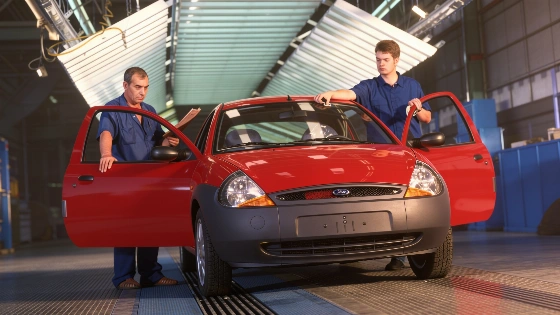
The Fiesta became Almussafes’s defining car: by November 2011, 5,025,300 had left the plant, representing 35% of its recorded vehicle production at the time. Ford’s factory in Valencia province began making cars in 1976 and reaches its 50th anniversary in 2026. The first Fiesta rolled off the assembly line on 18 October 1976; the site had already produced its first engine on 1 March that year. Ford says Almussafes has since built more than 14.2 million vehicles and more than 18 million engines.
That run looks modest beside the Corolla’s global total: the Toyota had reached 57 million sales across 12 generations by 2026, while Almussafes built just over five million Fiestas in its first 35 years. The figures measure different things, global sales versus production at one plant, but put the Fiesta’s local importance into perspective.
Almussafes was chosen for its flat land and its proximity to the Sagunto steelworks and Valencia port, 25 kilometres away. Talavera de la Reina also competed for the factory. Ford bought 270 hectares made up of 636 agricultural plots, including land belonging to Rafael Romaguera, whose family would have ties to the plant for three generations. Developing the site marked Ford’s return to Spanish manufacturing after it withdrew from the country in 1944.
The first car rolled off the line on 18 October 1976, seven days before King Juan Carlos inaugurated the factory. Engine production had started earlier that year: Almussafes made 147,953 engines against 17,508 cars. The Fiesta was Ford’s first vehicle manufactured entirely in Spain. Earlier cars assembled in Cádiz and Barcelona used parts brought in from abroad.
Ford called the small car Project Bobcat during development, and it nearly received other names. Henry Ford II favoured Fiesta after persuading Tom Murphy, then president of General Motors, to release a name that had been unused for several years. The first full year of Fiesta production brought 213,897 cars. Output peaked at 267,970 in 1978, while buyers faced waiting lists of more than a year in April 1977. Almussafes reached its first million Fiestas on 2 January 1981.
Almussafes built no other model during its first five years of car production. The Escort joined the line in August 1981, after the Fiesta had passed one million units that January. The Fiesta’s adapted Ford Kent OHV engine became known as the Valencia engine, after the plant. Ford’s manufacturing history records that the factory reached 10 million engines in 2000 and completed its 10-millionth vehicle in 2009.
Production later expanded beyond Ford’s own range. In 2004 the factory made 449,101 vehicles, its highest annual total at the time. That tally included 71,783 Fiesta, 78,642 Ka, 257,267 Focus and 41,409 Mazda2. The Mazda2 was built there from 2003 to 2007; it was the first Mazda model produced in a European factory and the first non-Ford model at Almussafes. Built on the same assembly line as the Fiesta, the Mazda2 reached 161,962 units before production ended on 22 June 2007, Auto Bild España reported.
Exports came to dominate the operation. The factory’s recorded total is 11,244,124 exported vehicles, 79% of production. Its annual export record came in 2017 at 398,226 vehicles. Exports never fell below 86% of output between 2013 and 2022.
The factory’s cars also made their mark in motorsport. Carlos Sainz won the 1987 Spanish Rally Championship in a Ford Sierra RS Cosworth with Antonio Boto, then took the 1988 title with Luis Moya. In 1997 Sainz and Moya secured M-Sport’s first World Rally Championship victory in the Rally Acrópolis, driving a Ford Escort WRC.
The plant’s later milestones included Ford’s first hybrid made in Europe, the Mondeo Hybrid. By 2025 its engine production had exceeded 18 million. The factory also received four Henry Ford technology awards between 2023 and 2025 for the AiTRIZ and ASPS projects in 2023, AI ToolSense in 2024 and Galata in 2025. By its 50th anniversary in 2026, Ford reported more than 14.2 million vehicles and more than 18 million engines produced at Almussafes.
A historic agreement with Grupo Social ONCE / ILUNION established special employment centres for people with disabilities within the Almussafes complex. The plant’s next phase is also being planned: reports say new Ford vehicles and models using Geely technology are expected from 2028, with a new corporate structure expected to begin operating in the first half of 2027. In late 2026, the Kuga was the only model then in production at the factory.