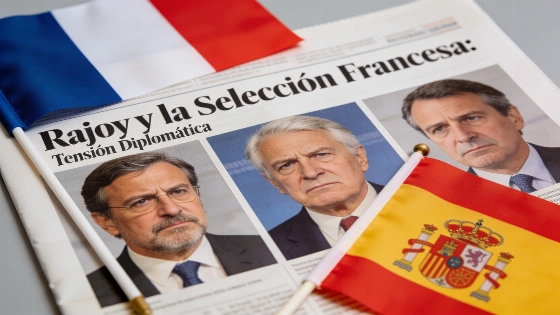
French ministers have sharply criticized Mariano Rajoy after he questioned the French team's identity. The Spanish Prime Minister also responded, calling for unity and rejecting xenophobia. The incident has sparked diplomatic tension ahead of the Spain-France World Cup semifinal.
French authorities have strongly denounced statements made by former Spanish Prime Minister Mariano Rajoy, who claimed in a recent article that the French national football team plays "without Frenchmen." The remarks, published in El Debate just days before the Spain-France World Cup semifinal, have been labeled "racist" and "unacceptable" by several members of the French government.
Three ministers from Emmanuel Macron's cabinet, including the Minister of the Interior Laurent Nuñez, the Minister for the Fight Against Discrimination Aurore Bergé, and the Minister for Overseas Territories Naïma Moutchou, publicly condemned Rajoy's comments. Nuñez, himself of Spanish descent, stated on BFMTV that such assertions are "completely unacceptable" and emphasized that France is a republic where everyone can find their place, regardless of origin. Bergé criticized what she described as repeated racist remarks, insisting that sport should be judged solely on talent. Moutchou went further, urging the French Football Federation to consider legal action against Rajoy.
The controversy began after Rajoy's column in El Debate, a publication owned by the Asociación Católica de Propagandistas, where he analyzed the French squad ahead of their match against Spain. Rajoy argued that the team, despite its high level of play, does not include "Frenchmen," apparently conflating nationality with ancestry. This perspective has previously appeared in far-right French discourse, particularly since the 1998 World Cup victory.
Political leaders across the French spectrum joined the criticism. The French Communist Party's Fabien Roussel referenced recent racist incidents involving France, while Socialist leader Olivier Faure stressed that France is not defined by ethnicity, skin color, or religion, but by its republican values. The French Embassy in Madrid also responded, clarifying that all 26 players called up for the national team are French citizens, with 23 born in France and the remaining three holding French nationality.
In Spain, Prime Minister Pedro Sánchez addressed the issue on X, contrasting those who judge belonging by name or birthplace with those who value commitment to the country. He called for the defeat of racism and expressed support for France ahead of the semifinal. Transport Minister Óscar Puente also criticized Rajoy, describing him as a "post-Francoist idiot" and denying his reputation as a moderate.
This diplomatic incident comes at a sensitive moment, with the Spain-France World Cup semifinal drawing significant attention. The debate over national identity in football is not new in France, where the composition of the national team has often sparked political and social discussion. The French Football Federation has not yet announced any formal response to the calls for legal action. The episode highlights ongoing tensions in Europe regarding migration, integration, and the meaning of national identity, especially in high-profile international events.
France's approach to citizenship is based on the principle of jus soli, granting nationality to those born on French soil or to parents with French citizenship. This model contrasts with more restrictive approaches in other countries and has shaped the country's diverse national teams for decades. The current controversy underscores how questions of identity and belonging remain deeply sensitive, particularly when amplified by political figures and major sporting events.