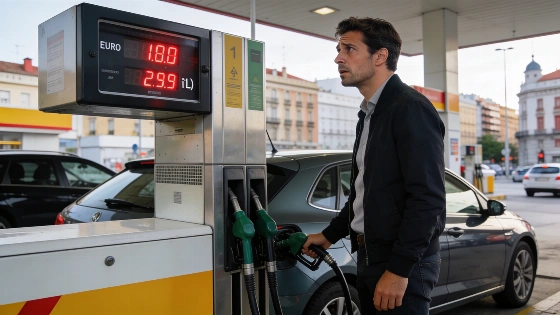
Spanish drivers are now paying up to 2.23 euros per litre for fuel, with prices in September 2026 varying sharply by city and putting extra strain on household budgets.
On Wednesday, September 16, 2026, drivers across Spain faced steep new prices at the pump. The average cost for gasoline 95 and diesel hit 1.89 euros per litre, while gasoline 98 climbed to 2.1 euros. In Madrid and Barcelona, some stations charged more than 2.2 euros for premium fuel. For many, filling up is no longer routine—it’s a calculation of what’s necessary.
Prices now swing widely from one station to another. In Madrid, diesel ranged from 1.759 to 2.129 euros per litre. Barcelona’s prices ran from 1.71 to 2.059 euros. Valencia, Granada, and Málaga showed similar spreads, while Ceuta stood out for its flat rate of 1.674 euros per litre. Gasoline 95 followed the same pattern, with Madrid’s prices between 1.729 and 2.129 euros, and Barcelona’s from 1.734 to 2.089 euros. The difference between the cheapest and most expensive stations is now big enough that drivers are planning routes to save money.
European Commission Oil Bulletin
For drivers of high-performance cars, the jump is even sharper. Gasoline 98, which is recommended for more powerful engines, now costs between 1.959 and 2.239 euros per litre in Barcelona, and up to 2.229 euros in Madrid. The price gap with regular gasoline is no longer small—it’s a clear extra cost for those who need or prefer higher-octane fuel. Official reports put the average price of gasoline 98 at about 2.06 €/l on September 14, confirming that premium fuel has crossed the 2-euro mark in most places.
Several factors are pushing prices up. Global oil markets play a role, but so do local competition and regional tax differences. According to Google/SpainAuto, the average price of gasoline rose by 1.42% in a single day, while diesel went up by 1.71%. For families and commuters, these daily changes mean real money lost or saved, depending on where and when they fill up. Market summaries for September 15 and 16 show the trend continuing: gasoline 95 rose from 1.886 €/l to 1.901 €/l, and diesel from 1.868 €/l to 1.885 €/l. This isn’t a one-off spike, but a steady climb.
The differences between fuel types matter more than ever. Gasoline 95, with lower density and a cleaner burn, is standard for smaller engines in Europe. Gasoline 98, with a higher octane rating, is aimed at cars that need more power and cleaner engine performance. Diesel, still common in Spain, is used by long-distance drivers and commercial fleets, but its price advantage is shrinking quickly.
Independent Spanish market reports
With prices rising, drivers are looking for ways to save. The Dirección General de Tránsito de España (DGT) recommends traveling light, accelerating gently, keeping filters clean, and maintaining tire pressure. These steps can help reduce fuel use, but they do little to offset the steady rise in prices.
The impact on households is immediate. Higher fuel costs affect everything from grocery deliveries to weekend trips, and the lack of price stability makes it hard to budget. The government has few options, since most of the price is set by international markets and long-standing tax rules. Unless there’s a major change in global oil or a new policy, drivers will keep feeling the squeeze.
As prices at the pump keep rising, one thing is clear: cheap fuel in Spain is gone for now. For those who rely on their cars, every litre now matters more than ever. This isn’t just a temporary spike—it’s a new reality that will test how Spanish consumers adapt in the months ahead.