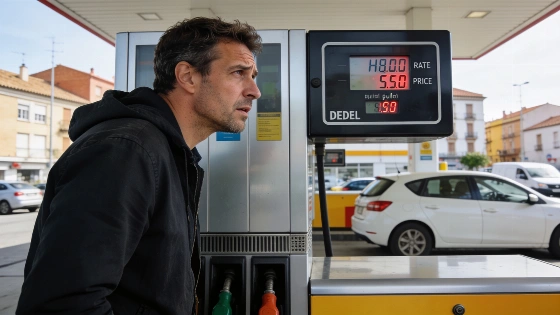
Fuel shortages at French service stations are forcing Spanish transport companies to fill up before crossing the border. With diesel prices climbing and supply gaps on key routes, hauliers are changing how and where they refuel.
When almost one in five French service stations runs out of at least one type of fuel, Spanish hauliers pay attention. This is no longer just a warning. French Minister of Economy Roland Lescure confirmed that 17% of stations were missing at least one fuel type. That is about 1,500 locations. For the 20,000 Spanish trucks crossing the Pyrenees every day, this is more than a hassle. It is a real threat to their operations.
But official French government data and recent reports show the actual number was closer to 11% as of September 18. Earlier, authorities put the figure at around 10%. The French Ministry of Energy, through Maud Bregeon, says there is no national fuel shortage. They call the problem local and say they are watching it closely.
The Federación Nacional de Asociaciones de Transportes de España (Fenadismer) moved fast. Their advice to international hauliers was simple: fill your tanks before leaving Spain. This is not just about saving money. It is about making sure trucks do not get stuck in France where diesel might not be available.
The shortages come from a mix of policy and market moves. The French government and TotalEnergies set a voluntary price cap on some fuels. Because of this, TotalEnergies stations—90% of those hit by shortages—sell diesel well below the national average. Sometimes it is under 2 euros per litre, while other stations charge 2.40 to 2.50 euros. This has led to higher demand, local shortages, and a rush for fuel, especially in the northeast and east of France.
Not every Spanish transport group sees a crisis. Ramón Valdivia, executive vice president of the Asociación de Transporte Internacional por Carretera (Astic), says most Spanish trucks carry enough fuel for the round trip. For now, he says, problems are rare and mostly affect TotalEnergies stations. Still, Fenadismer tells companies to watch fuel levels closely and plan routes to avoid trouble spots.
Regional disparities are notable: areas such as Grand Est, Pays de la Loire, Occitanie, and Centre-Val de Loire have reported above-average rates of fuel shortages, according to several French media and government updates. Despite these local spikes, strategic reserves remain full and refineries are operating normally, as confirmed by French authorities.
France’s need for imported diesel has made things worse. After sanctions on Russia, France had to find new suppliers. Now it buys from other European countries, the Middle East, the United States, and India. This change, along with global market pressure and shipping problems in places like the Strait of Hormuz, has made it harder to get refined fuel across Europe.
The problem is not just about moving goods. It is also about cost. Eurostat says fuel and lubricant prices for personal transport in the EU jumped 23.8% year-on-year in August. In France, the rise was 27.4%. Diesel prices alone went up 8.3% between July and August, rising faster than petrol. The price gap between France and Spain is now so big that French drivers are crossing the border to fill up, saving up to 41 cents per litre—about 20.50 euros on a 50-litre tank.
For Spanish hauliers, the main concern is not finding the cheapest fuel. It is making sure trucks can keep moving. The risk of empty pumps on French routes has forced companies to rethink their plans. Fenadismer’s advice to fill up before crossing is not just smart—it is needed to avoid delays and breakdowns.
So far, there is no sign that the French shortages are spreading to Spain. Both Astic and Spanish energy officials say there is no evidence of spillover. But this episode shows how fragile Europe’s fuel supply chains are, and how quickly cross-border transport can be hit by policy changes and market shocks. Spanish hauliers are adjusting, but the bigger problems—unstable prices, changing supply routes, and political moves—are not going away. Even a voluntary price cap in one country can shake up logistics across the continent.