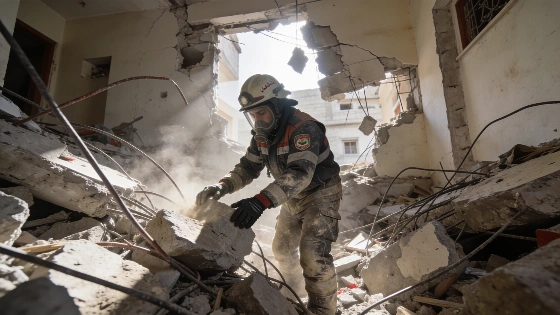
Bulldozers continue to clear the wreckage in Gaza. The Palestinian Civil Defense says more than 630 bodies and human remains have been recovered from beneath destroyed buildings since November 2025. Officials estimate that over 8,000 people are still missing, likely buried under rubble after years of bombardment. Figures from the Palestinian Civil Defense and the UN show the scale of the ongoing crisis.
The United Nations has accused Israel of systematically blocking recovery and identification efforts. Volker Türk, the UN High Commissioner for Human Rights, has called on Israel to allow international investigators into Gaza to collect evidence of possible human rights violations. Türk warns that ongoing military operations and the use of heavy machinery are destroying potential mass graves, making it harder to identify victims or notify their families.
Ajith Sanghai, who leads the UN human rights office in the Palestinian Territories, says large-scale search and recovery is nearly impossible. Sanghai says Israeli soldiers have crushed debris containing human remains and blocked specialized equipment and trained personnel from entering. The ban on forensic tools and identification kits has left many families unable to confirm the fate of their relatives. Reports from UN News and Anadolu Agency say limited access to heavy machinery and forensic resources has slowed recovery, leaving local teams to work by hand.
UN News reported that between 27 June and 27 August, local authorities recovered 233 bodies from 20 destroyed buildings in Gaza, including 74 children and 106 women.
“The remains found so far may represent only a fraction of the true toll,” Türk said, expressing concern that Israeli clearance of sites is happening with little regard for the dead. Without access for international teams, he warns, critical forensic evidence could be lost forever. Sanghai added that, at the current pace, recovering all the bodies could take a decade, with identification taking even longer.
For families in Gaza, the consequences are severe. Being unable to recover or identify relatives leaves them in limbo and deepens their suffering. The UN’s call for transparency and international oversight concerns justice, but also the restoration of dignity to those who have lost everything.
In September 2026, recovery teams in the Az-Zeitoun area found 96 bodies and remains at a single site, most of which had to be retrieved manually. Among the victims were 58 children and 23 women, a sign of how many families have been affected, UN News reported.
The loss in Gaza is staggering. Figures from the Palestinian Civil Defense and the UN represent thousands of families still waiting for answers. Israel’s blocking of recovery efforts raises serious questions about accountability and respect for basic human rights. Preserving evidence matters for justice and for the dignity of the dead and the families left behind. Without immediate international intervention, the truth behind these disappearances may be lost along with the victims themselves.