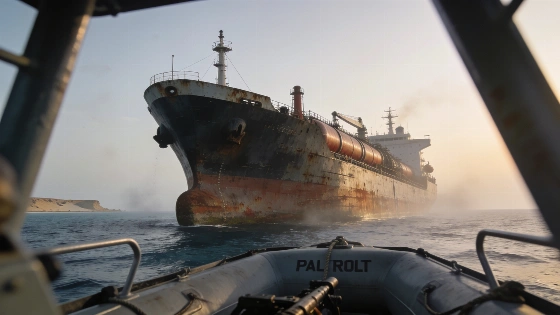
Five crew members died during the rescue of the Honour 25. A second tanker was freed without fatalities. European naval data show that the threat has moved back toward Somalia's coast.
The Honour 25 was carrying 18,500 barrels of crude oil when pirates seized it off Somalia in April. Five crew members died during the rescue months later. The attack shows how piracy has returned to Somali coastal waters after more than a decade of lower activity.
Protected shipping lanes tell a different story. Near the coast, armed groups still find room to operate.
According to authorities in the secessionist region of Puntlandia, the pirates executed three Pakistani sailors, one Indian national and one Burmese crew member before they were subdued. Images obtained by RTVE show the violence on board the tanker.
Puntland authorities said that 16 suspected pirates were detained during the Honour 25 rescue operation on 29 September 2026.
The same operation did not end the recent run of incidents. Reuters reported that pirates seized the Honour 25 on 21 April. The vessel remained in their hands for months.
That was no short coastal raid.
The vessel Sibu 1 was released last Friday after Puntlandia police and Iraqi paramilitaries took part in the operation. The shipowner, a businessman from Basra in Iraq, hired the Iraqi force directly. No deaths were reported during that rescue.
The two cases ended very differently. One recovery turned into a lethal confrontation. The other ended without reported fatalities.
Farther offshore, the picture is different. EUNAVFOR's Operación Atalanta has almost eliminated piracy in international waters across the Somali basin and the Indian Ocean during the past five years. The mission operates under Spanish strategic command from the Base Naval de Rota, Cádiz.
It has escorted more than 2,518 vessels. It has also secured the delivery of over 3.3 million tonnes of humanitarian aid and food to Somalia's shores.
UKMTO reported that Sibu 1 was seized about 136 nautical miles east of Al Mukalla, Yemen. Reuters described the incident as at least the 13th attack near Somalia or in the Gulf of Aden in 2026, showing that pirate operations can reach well beyond the immediate shoreline.
The mission's enforcement record is substantial. Its forces intercepted 177 suspected pirates and handed them over to the competent authorities. Courts convicted 145 of them.
Yet EUNAVFOR's own figures show that piracy in Somalia's territorial and coastal waters reached levels in 2026 not seen for more than ten years. Naval protection has contained the threat offshore. It has not removed the conditions that let piracy return close to land.
Sibu 1 showed the scale of the regional response. Lloyd's List reported that Puntland forces arrested 47 suspected pirates after a two-day operation. The vessel was released without reported fatalities.
Regional forces can act.
Other hijacked vessels remain in the area. The crisis is not over.
The coast remains tied to Somalia's internal security problems. Diplomatic sources and the European naval mission point to continuing difficulties in building security on land. Al-Shabaab also gives maritime criminal networks access to safe havens along the shoreline.
Naval resources are under pressure elsewhere. Houthi rebels in Yemen have launched missile and drone attacks against shipping. International forces have moved important assets toward air defence around the Bab el-Mandeb strait.
That shift has left patrol areas in the Somali basin with less attention. The worsening war involving the United States and Israel against Iran has added to the strain. The partial blockade of the Strait of Hormuz is also disrupting established trade routes and creating security gaps in the western Indian Ocean.
An earlier border report described how regional insecurity can place greater responsibility on Europe. In the Horn of Africa, the immediate cost is clear. Commercial vessels are being hijacked. Rescues are turning dangerous. Crew members are dying.
Arab News reported that at least two other tankers, MT Eureka and MT Asana, remained in pirate hands alongside Sibu 1 and Honour 25. Pirates moved the vessels toward the Hobyo area in Galmudug.
This points to linked or parallel hijackings. It is not one isolated case.
Atalanta's record shows that sustained naval protection can make international waters safer. Honour 25 and Sibu 1 show where that protection stops.
Somalia's piracy problem has not returned everywhere at once. It is concentrated where coastal insecurity, protected havens and diverted naval attention overlap. Commercial shipping now faces a renewed coastal threat. Regional instability is giving pirates the opening they need.