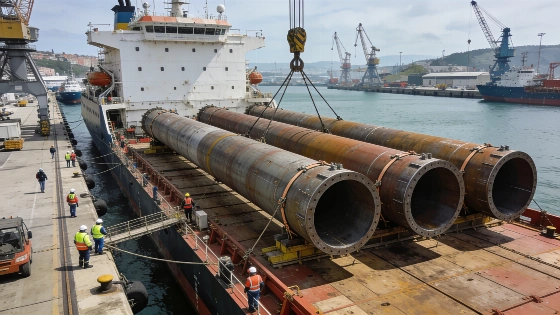
The Trustee, a semi-submersible ship operated by Boskalis, is transporting massive steel monopiles from Bilbao to Teesworks for Hornsea 3, set to become the world’s largest individual offshore wind farm. Each voyage carries three foundations, supporting a project that will power over 3 million UK homes.
Three colossal steel monopiles, each stretching up to 90 metres and weighing more than 1,600 tonnes, are now making their way from Bilbao to the northeast coast of England. The Trustee, a semi-submersible vessel operated by Boskalis, is at the heart of this operation, ferrying these oversized structures to Teesworks for the construction of Hornsea 3—soon to be the world’s largest single offshore wind farm.
Every journey of the Trustee begins at the port of Bilbao, where the foundations are manufactured by Haizea Wind Group. The ship, converted in 2008 for heavy and oversized cargo, measures nearly 217 metres in length and 44.5 metres across. Its vast deck, spanning 130 metres, allows it to carry three monopiles at a time—an engineering feat that would be impossible for conventional cargo ships. During transit, the monopiles are secured with custom supports and lashings designed to withstand the ship’s movement at sea.
According to Boskalis, the Trustee will make multiple trips over the coming months, steadily supplying the UK’s east coast with the foundations needed for Hornsea 3. The first six monopiles arrived in Teesside in February, covering a distance of roughly 960 nautical miles from Bilbao. While the Trustee is a key player in this logistics chain, it will not transport all 197 foundations required for the project.
Engineering at Scale
Monopiles are the backbone of offshore wind turbines, anchoring them to the seabed and supporting the towers above. Haizea Wind Group’s Bilbao facility, covering more than 200,000 square metres and employing over 900 people, has been expanded with an investment exceeding €250 million to meet international demand. The plant’s ability to produce XXL foundations has positioned Bilbao as a critical hub in the global offshore wind supply chain.
Official figures show that the first monopiles for Hornsea 3 measured around 90 metres and weighed an average of 1,670 tonnes. However, later deliveries have included even larger pieces—over 105 metres long, up to 11 metres in diameter, and weighing as much as 2,300 tonnes. Not all 197 foundations will be identical, as each batch is tailored to specific site requirements.
Hornsea 3: A New Benchmark
Hornsea 3 is taking shape in the North Sea, about 120 kilometres off the Norfolk coast. Developed by Ørsted, the project will feature 197 wind turbines with a combined capacity of 2.9 GW—enough to supply more than 3.3 million British homes. The first foundation was installed in May 2026, with the remaining 196 scheduled for completion through 2027. The overall project is expected to be finished by the end of that year.
The Trustee’s role is strictly logistical, delivering monopiles to the UK’s onshore storage site. Offshore installation is handled by other specialist vessels: Cadeler is responsible for marine transport and installation, with the Wind Ally driving the monopiles into the seabed and the Wind Orca adding secondary steel components. This division of labour highlights the complexity and scale of modern offshore wind construction.
Bilbao’s Growing Industrial Role
The contract has elevated Bilbao’s status in the offshore wind industry, linking local manufacturing, port logistics, and heavy transport to one of Europe’s most ambitious energy projects. Haizea’s Bilbao plant now employs over 900 people locally and more than 1,500 across the group, with roles ranging from advanced welding to technical engineering. The Trustee’s repeated voyages underscore the region’s industrial capabilities and the strategic importance of Spanish manufacturing in the European energy transition.
As the Hornsea 3 project advances, the steady flow of XXL monopiles from Bilbao to the UK not only supports a landmark renewable energy development but also cements Spain’s position in the global offshore wind supply chain. The operation demonstrates how industrial investment and international collaboration are reshaping the future of energy infrastructure across Europe.