Residents in Girona's Barri Vell are pushing to end tax breaks for film crews. Locals say repeated shoots disrupt daily life and want production companies to pay full municipal fees.
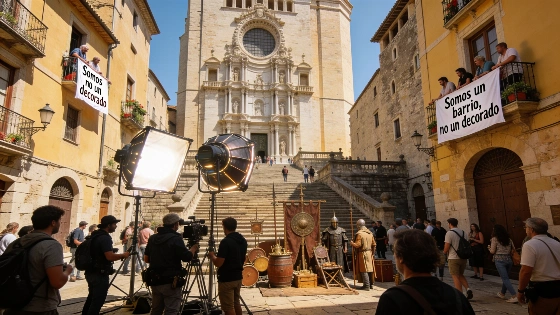
In Girona's Barri Vell, a new dispute has erupted as residents call for an end to municipal fee exemptions for film productions using the city's historic streets. The latest trigger is Disney's live-action adaptation of Enredados, which has transformed the iconic cathedral steps and surrounding areas into a medieval set. While crews of up to 500 people work on elaborate scenes, banners have appeared on balconies with messages like “Somos un barrio, no un decorado” and “Queremos un barrio para vivir, no para sobrevivir.”
The neighborhood association Barri Vell-Mercadal is preparing a formal motion for the city council, demanding that audiovisual companies pay the standard municipal rate for occupying public spaces. Residents argue that current tax breaks and exemptions for film, television, and video shoots unfairly shift the burden of costs—such as mobility restrictions, security, cleaning, and wear on public infrastructure—onto the local community. The association insists that any use of public space should serve the general interest, and proposes that revenue from these fees be reinvested in heritage conservation, public space improvements, and compensation for affected residents and businesses.
The draft motion also calls for stricter controls on filming schedules: setting annual limits on shoot days, mandating rest periods between productions, and banning commercial shoots on weekends, holidays, or during peak event seasons. Additional measures would protect residents from excessive noise and light disturbances.
For many locals, the Disney production is only the latest example of a broader trend. They point to a steady increase in large-scale events, festivals, and tourism that, in their view, have eroded the neighborhood's residential character. Some residents recall a time when Barri Vell was defined by local shops and daily routines, not by constant closures and disruptions. The sense of frustration echoes debates in other Spanish cities, such as Valencia, where the planned demolition of Mestalla stadium has raised concerns about the loss of urban identity—an issue explored in recent coverage of Valencia's urban development controversies.
City officials in Girona defend the current policy, arguing that film shoots bring international attention and economic benefits. According to municipal sources, productions like Tomb Raider for Amazon Prime Video have generated significant local revenue, with the last major shoot estimated at €1.4 million. The city acknowledges the inconvenience to residents and says it works to minimize disruption through advance notice, direct communication with neighborhood groups, and open meetings. The tourism sector also highlights the promotional value of these productions, though some guides admit that filming can complicate their work, especially during busy periods.
The debate in Girona reflects a wider challenge faced by historic cities balancing economic opportunity with quality of life for residents. As the Barri Vell continues to attract major productions, the outcome of the residents' motion could set a precedent for how Spanish cities manage the intersection of heritage, commerce, and community interests. In Spain, the use of public spaces for commercial purposes is typically regulated at the municipal level, with local councils setting fees and conditions. The growing popularity of Spanish locations for international shoots has intensified scrutiny of these policies, especially in areas with high tourism and limited residential space. The situation in Girona may influence future decisions in other heritage-rich cities navigating similar pressures.