A video showing gold-like fragments in a pan, attributed to Santiago Alba, has circulated online since early 2025. The lack of location, weight, or independent analysis leaves the true nature of the find in question, despite scientific evidence of gold deposits in Extremadura.
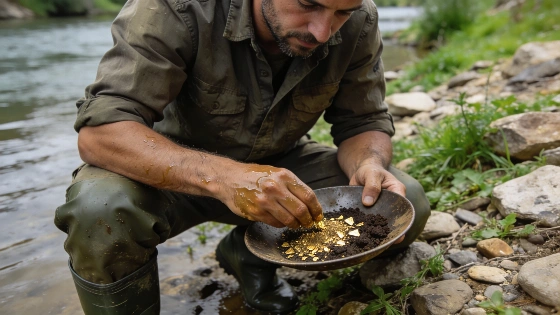
When a video surfaced online showing a pan filled with glittering gold fragments, attributed to Santiago Alba and the account @s.a.m_gold_digger, it quickly caught the attention of treasure seekers and curious viewers alike. The footage, which claims to capture the results of a weekend gold hunt in Extremadura, has been reposted multiple times since January 2025, most recently in August 2026. Yet, despite its viral appeal, the video offers few verifiable details: there is no mention of the river, the exact location, the weight of the fragments, or any independent mineralogical analysis.
According to the description, the fragments were collected after a weekend of panning in an undisclosed river in Extremadura. However, as noted by Talent24h, the same video has been recycled in several publications over the past two years, each time repeating the phrase “another weekend searching for gold in Extremadura.” This repetition, combined with the absence of concrete data, has led to skepticism about whether the find is recent or even authentic.
What the video does show is a pan containing small, shiny particles mixed with dark sediment. While the user presents these as gold, there is no way to confirm their composition, size, or value from the footage alone. The Spanish Geological and Mining Institute (IGME) points out that most gold found in the region’s alluvial deposits appears as tiny flakes or millimeter-sized fragments, rarely as large nuggets. Without a proper analysis, it is impossible to determine how much gold, if any, is actually present in the pan.
Scientific Evidence and Local Geology
Despite the uncertainty surrounding this particular video, the presence of gold in Extremadura is well documented. Research by the IGME and the University of Salamanca has identified several types of gold deposits in the region, including quartz veins, ancient alluvial deposits, and placer gold in current river systems. Notable sites include El Chivote, La Pedrera, Las Cavenes, Sierro de Coria, the Erjas River, and Casillas de Coria, each associated with different geological formations and gold-bearing sediments.
Some studies also mention discoveries near Casas de Don Pedro, northeast of Badajoz, where fluctuating water levels and soil erosion help concentrate gold particles near the surface. These findings confirm that small amounts of gold can be found in Extremadura’s rivers and soils, though they do not prove that the material shown in the video comes from any of these locations.
The Panning Process and Its Limits
Panning for gold relies on the metal’s high density. Sediment is collected from the riverbed, placed in a pan, and washed with water in a circular motion. Lighter materials are gradually removed, leaving heavier minerals—potentially including gold—at the bottom. These accumulations, known as placers, often form where the river slows, behind rocks, or in bends. However, most gold recovered this way is in the form of fine particles, not large nuggets, and requires careful handling to avoid losing the smallest fragments.
After removing larger stones, the prospector continues washing until only a small amount of heavy sediment remains. The tiniest pieces are often collected with a pipette. The process is labor-intensive and rarely yields significant quantities unless the area is particularly rich in gold.
Legal and Environmental Considerations
Spanish law, specifically Ley 22/1973, de Minas, classifies all naturally occurring mineral deposits as public property. Only minor, occasional extraction by landowners for personal use is exempt, and even then, only if no mining techniques are used. Panning in public waterways does not automatically fall under this exception. The Guadiana River Basin Authority requires permits for extracting riverbed materials, and the need for authorization depends on the location, amount of sediment moved, tools used, and environmental protections in place. Prospective gold hunters are advised to consult both the regional mining authority and the relevant river basin authority before attempting any extraction.
While the video attributed to Santiago Alba is visually striking, it does not provide enough information to confirm a new or significant gold discovery in Extremadura. The footage has circulated online for over a year, and without independent verification, its authenticity remains uncertain. Still, the scientific record supports the possibility of finding small gold particles in the region’s rivers—a fact that continues to attract amateur prospectors.
For those interested in remarkable engineering feats beneath rivers, the recent completion of an 11-kilometer tunnel under the Yangtze River using the Linghang tunnel boring machine demonstrates how technology is transforming access to natural resources and infrastructure. More details on this achievement can be found in this report on the Yangtze tunnel project.