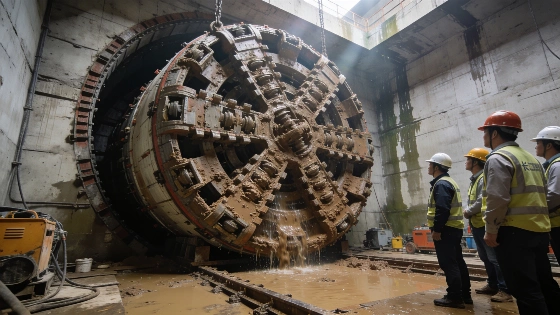
The Linghang tunnel boring machine has finished excavating over 11 kilometers beneath the Yangtze River, reaching depths of nearly 90 meters. This engineering feat paves the way for high-speed trains to cross between Shanghai and Taicang in just minutes, reshaping regional transport.
On March 29, 2026, the Linghang tunnel boring machine reached the southern bank of the Yangtze River, completing an uninterrupted 11.18-kilometer drive beneath the riverbed. The machine began its journey on April 29, 2024, from Chongming Island in Shanghai, and after 23 months of continuous progress, emerged in Taicang, marking a milestone in large-scale tunnel construction.
According to the Chinese Ministry of Transport, Linghang's achievement stands as the longest single-drive excavation ever completed by a tunnel boring machine (TBM) of its size—15 meters in diameter—without being dismantled or relocated. While the total planned tunnel length from the initial shaft is 11.325 kilometers, the completed underwater section measures 11.18 kilometers, a distinction that highlights the scale of the operation.
Engineering at Extreme Depths
Weighing around 4,000 tons and stretching 148 meters in length, Linghang was purpose-built to withstand the immense pressures found nearly 90 meters below the Yangtze. Its cutting head, measuring 15.4 meters across, is equipped with advanced wear-resistant technology to handle abrasive silt and sand. The TBM features the I-TBM intelligent system, which monitors chamber pressure, machine trajectory, and material removal in real time, ensuring both safety and precision.
As Linghang advanced, it installed prefabricated concrete rings to form a watertight tunnel lining, crucial for withstanding pressures up to 0.9 megapascals. The route crossed not only the main river channel but also dikes, waterlogged soils, and protected fishery zones, demanding both technical innovation and environmental care.
High-Speed Rail Transformation
The Chongtai tunnel, once operational, will span 14.25 kilometers and accommodate two high-speed rail tracks within a single gallery. Designed for trains traveling at up to 350 km/h, the tunnel's large diameter helps minimize air pressure fluctuations—known as the piston effect—that can impact both passenger comfort and infrastructure integrity. This approach mirrors solutions used in major European projects, such as the Alpine base tunnels, to ensure smooth, high-speed transit.
When the new corridor opens, Chongming will be directly linked to China's high-speed rail network. Authorities in Suzhou estimate that the journey from Chongming to Shanghai Baoshan station, via Taicang, could be reduced to just 17 minutes. Official documents suggest the tunnel will be ready for service in the second half of 2029.
Record-Breaking, but Not the Largest
While Linghang holds the record for the largest-diameter TBM used in a high-speed rail project, it is not the absolute largest ever built. The Guinness World Records lists the Herrenknecht Mixshield S-880 Qin Liangyu, used for a road tunnel in Hong Kong, as the biggest, with a shield diameter of 17.63 meters and a weight of 4,850 tons. However, Linghang's achievement is unique for its application in high-speed rail and the length excavated from a single starting point.
Context and Global Perspective
This tunnel is part of a broader push to modernize China's transport infrastructure, joining other ambitious projects like the Bohai Strait tunnel. The scale and complexity of such undertakings echo developments in other countries, including Russia's recent advances in submarine technology, as seen with the Pacific Fleet's new Yasen-M class submarine detailed in this report on Russia's nuclear submarine Perm. Together, these projects reflect a global race to master engineering challenges beneath water and earth, reshaping how nations connect and defend their territories.
As the Linghang TBM undergoes final maintenance in Taicang, attention now turns to the tunnel's completion and the transformative impact it promises for high-speed rail travel across eastern China.