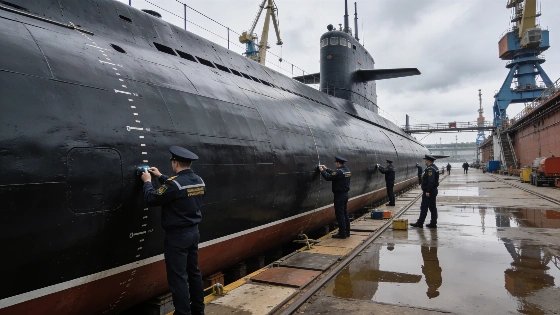
The Russian Navy plans to commission the nuclear-powered submarine Perm, a 130-meter Yasen-M class vessel designed to launch Zircon hypersonic missiles, by the end of 2026. The submarine is currently undergoing sea trials before joining the Pacific Fleet.
The Russian Navy is preparing to introduce the nuclear-powered submarine Perm, a 130-meter Yasen-M class vessel, into its Pacific Fleet by the end of 2026. The Perm, which displaces approximately 13,800 tons when submerged, is currently in the final stages of testing before formal acceptance. According to Admiral Alexander Moiseyev, the timeline remains provisional and depends on the successful completion of all remaining trials.
Launched on March 27, 2025, at the Sevmash shipyard in Severodvinsk, the Perm represents the latest evolution of the Yasen-M project, designed by the Malakhit design bureau. The nearly nine-year construction period reflects the complexity of integrating advanced systems, including a nuclear propulsion unit that enables extended patrols and long-range operations. The submarine measures 130 meters in length and 13 meters in beam, placing it among the largest attack submarines in service.
What sets the Perm apart is its role as the first serially built Yasen-M submarine equipped to carry the 3M22 Zircon hypersonic missile. Russian officials claim the Zircon can reach speeds close to Mach 9 and strike targets over 1,000 kilometers away, with the ability to engage both naval and land-based objectives. However, these performance figures are based on official statements and have not been independently verified. The submarine's launch architecture also supports Kalibr and Oniks missiles, allowing for flexible mission profiles and up to 32 cruise missiles, depending on operational requirements. In addition, the Perm is armed with torpedo tubes for anti-ship and anti-submarine warfare.
The vessel's displacement of 13,800 tons refers to its submerged weight, while its surface displacement is around 8,600 tons. The substantial internal volume accommodates the nuclear reactor, sonar arrays, protective systems, and crew quarters. Nuclear propulsion grants the Perm significant operational autonomy, though patrol duration remains limited by crew needs and onboard supplies. Acoustic stealth and other performance metrics are largely classified, with most available data coming from manufacturer estimates.
While the Perm is nearing completion, Russia is also advancing the Poseidon unmanned underwater vehicle program. President Vladimir Putin recently stated that Poseidon is in its final development phase, but did not specify a deployment date. Unlike the Perm, Poseidon is not part of the Yasen-M armament and serves a distinct strategic deterrence function. Many technical details about Poseidon remain undisclosed, and its operational status is not independently confirmed.
The introduction of the Perm comes as Russia continues to modernize its naval forces, with plans to receive 21 new vessels by the end of the year. This push for advanced maritime capabilities echoes the high-profile investments seen in other sectors, such as the luxury yacht market, where figures like Nik Storonsky have drawn attention for their ambitious acquisitions, as highlighted in a recent report on a €350 million superyacht lawsuit.
As the Perm completes its final trials, its integration into the Pacific Fleet will mark a significant step in Russia's ongoing efforts to enhance its underwater strike capabilities. The vessel's deployment is closely watched by military analysts, given the strategic implications of fielding submarines capable of launching hypersonic missiles.