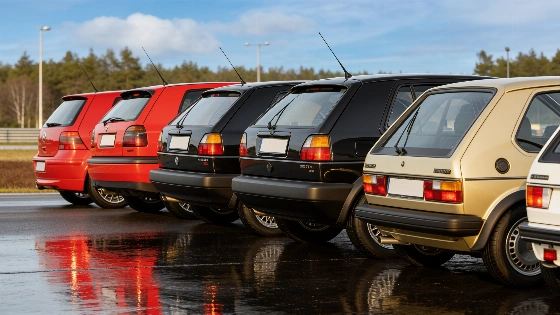
From the raw power of the original to the turbocharged precision of later models, the Golf GTI has shaped the hot hatch world for five decades. We put the first four generations through their paces to reveal which classic GTI truly stands out today.
It takes only a few seconds behind the wheel of a Volkswagen Golf 1 GTI to see why this compact hatchback became a cult favorite. The 1978 original, finished in Alpine White with 13-inch steel wheels, still feels lively in a way that modern cars rarely do. At just 780 kilos, it darts through corners with a directness that makes you forget about horsepower numbers or flashy styling. The car’s appeal is all about how it drives, not how it looks on paper.
The GTI story isn’t just about looking back. Over eight generations and more than 2.5 million cars sold, the Golf GTI has kept redefining what a practical sports car can be. The first four generations, each with their own quirks and breakthroughs, still set the standard for fans and collectors. But which one stands out now?
Volkswagen officially marks 1976 as the debut year of the first Golf GTI, though some retrospectives reference 1978 as the model year for certain early versions.
Icons and outliers
The Golf 1 GTI Pirelli, launched in 1983 as a farewell to the first generation, is a standout for its mix of style and substance. Its 14-inch Pirelli alloy wheels, double headlights, and green-tinted glass and leather interior made it more than just a cosmetic update. The 1.8-liter engine gave it a slight edge over the original 1.6, but it’s the limited run—just 10,500 cars—and unique features that make it a collector’s favorite.
The Golf 2 GTI 16V pushed things further. Early versions, built before catalytic converters were required, had a 139-horsepower engine that delivered a raw, unfiltered drive. The rear-mounted, angled antenna became a symbol of 1990s youth culture—so much so that theft was common. The G60 version, with its mechanical G-Lader supercharger, offered instant torque and a subtle look that only true fans would notice. Still, the G60’s quiet sound and slippery leather seats left some drivers missing the rougher edge of earlier models.
In 2026, Volkswagen and automotive communities across Europe are celebrating the 50th anniversary of the Golf GTI with special events, museum exhibitions, and track days, highlighting the model's ongoing cultural and historical significance.
Evolution and identity
By the time the Golf 3 GTI arrived, the car had grown in size and comfort. The extra weight and sturdier build brought new safety features, including the first dual airbags in a GTI. Electric windows, power mirrors, and a roomier interior signaled a shift toward a more mature car. The “Colour Concept” editions, with bold paint and matching leather seats, added some 1990s flair, but the car’s relaxed feel was a clear break from the rawness of earlier versions.
The Golf 4 GTI, introduced in 1997, struggled with its identity. Volkswagen’s move toward premium quality blurred the line between the GTI and regular models, making it hard to spot a real GTI at first glance. Inside, though, the details remained: aluminum trim, Recaro seats with bright red GTI logos, and a turbocharged 1.8-liter engine with 235 Nm of torque from just 1,950 rpm. The drive was more refined, but the GTI’s unique character risked getting lost among lookalike cars.
What sets a GTI apart
Each early GTI reflects its era, built to make daily driving more exciting. The original’s lightness, the Pirelli’s exclusivity, the 16V’s raw power, and the G60’s technical twist all shaped the GTI’s reputation. Later generations traded some of that edge for comfort and safety, following the changing tastes of drivers and new regulations.
What’s clear is that the Golf GTI’s appeal comes from its balance of practicality and real driving fun. The best GTI isn’t just the fastest or the most luxurious—it’s the one that makes every drive feel special, no matter where you’re headed.
After driving these classics again, it’s obvious that the original Golf 1 GTI still sets the bar for pure, unfiltered fun. Its simplicity, light weight, and eagerness to be pushed hard are qualities that modern cars rarely match. Later models brought technical progress and comfort, but also moved further from the raw spirit that made the GTI famous. For anyone chasing the true hot hatch experience, the first-generation GTI is still the reference point—proof that sometimes, less really is more.
The GTI badge started as a secret project at Volkswagen in 1975, led by Anton Konrad. The car’s success changed the brand and helped define an entire segment. As the GTI turns fifty, its legacy is secure, but the debate over which generation is best will keep going as long as drivers want that special feeling behind the wheel.