A political standoff is delaying the opening of a key A-11 motorway section in Valladolid. The Ministry of Transport and local authorities are at odds over safety and traffic impact. The conflict leaves a dangerous national road unchanged.
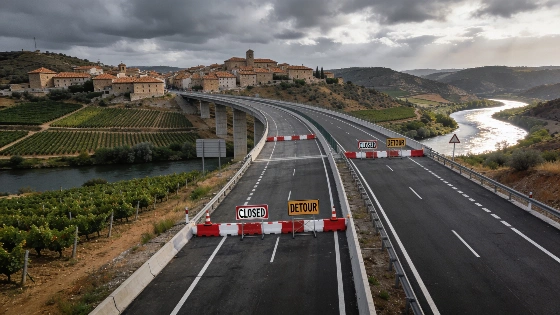
The opening of a 31-kilometre stretch of the A-11 motorway between Tudela de Duero and Valbuena de Duero has become the latest flashpoint between Spain’s Ministry of Transport and the regional government of Castilla y León, along with the Valladolid provincial council. Despite the new section being ready for traffic, local authorities have refused to authorise its use, citing concerns over road safety and the impact on smaller local routes.
The Ministry, led by Óscar Puente, argues that the new motorway segment could significantly reduce accidents on the notoriously dangerous N-122, a national road with a long history of fatalities and delays. According to Transportes, the Directorate General of Traffic (DGT) has issued a favourable report supporting the partial opening, provided that additional safety measures are implemented on affected local roads, including the VP-3301, VA-101, and the crossing through Pesquera de Duero.
However, the Junta de Castilla y León and the Diputación de Valladolid, both controlled by the Partido Popular, have pushed back. They warn that diverting traffic onto unfinished sections and minor roads could overwhelm local infrastructure, especially as the final bridge over the Duero river is still under construction. The Junta estimates that daily vehicle numbers on the VA-101 could nearly triple, with a sharp rise in heavy lorries, raising fears about road wear and risks for pedestrians, cyclists, and agricultural vehicles.
The Ministry has proposed a series of mitigation measures, such as new signage, intelligent traffic lights, and reinforced pedestrian crossings in Pesquera and Peñafiel. Officials insist these steps would keep long-distance heavy traffic on the N-122 and protect vulnerable road users in affected towns. Yet, the Junta maintains that the project is incomplete and that the proposed solution would simply shift accident risks from the national road to local routes, rather than resolving them.
On Wednesday, both sides met to discuss alternatives, but no agreement was reached. The Junta’s Mobility Department released a statement highlighting the lack of official information about the opening date and technical conditions for the new motorway section. The Ministry, in turn, accused the regional authorities of political obstruction, arguing that their refusal to cooperate is driven by electoral calculations rather than public interest.
This standoff is not unique in Spain’s transport sector. Regional disputes over infrastructure and funding have become increasingly common, as seen when Catalonia and Galicia challenged Madrid’s approach to public transport card funding—a situation detailed in a recent report on regional resistance to national transport initiatives.
The A-11, also known as the Autovía del Duero, is a strategic corridor linking Portugal and Aragón, but its completion has been repeatedly delayed. The N-122, which the new motorway is meant to replace, remains one of Spain’s most hazardous roads, with over 600 deaths in the past three decades and six fatalities recorded in 2026 alone. The Ministry stresses that opening the finished section could save lives, but the regional government insists that safety for local communities must come first. For now, the impasse leaves drivers and residents facing continued risks and uncertainty along the Duero corridor.
Spain’s regional infrastructure disputes often reflect deeper tensions between central and local authorities over control, funding, and priorities. The outcome of this conflict will likely influence future negotiations on major transport projects, especially in regions where local roads intersect with national corridors. As the debate continues, the need for coordination and clear communication between government levels remains a pressing issue for public safety and mobility.