The Spanish government allocated over €72,000 for an eclipse event at Yebes Observatory. The gathering included a VIP section, open bar, and 300 guests. The cost and exclusivity have sparked debate over public spending.
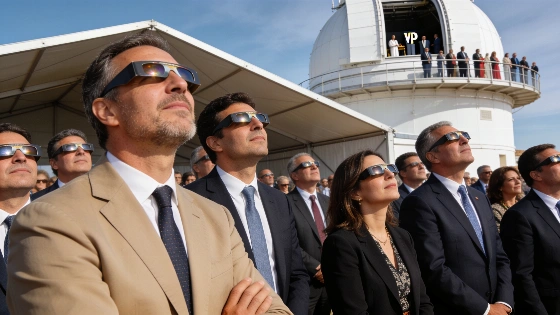
The Spanish government has allocated €72,358 for an official event at the Yebes Observatory in Guadalajara to mark the recent total solar eclipse, drawing attention for its scale and the inclusion of a VIP area. The gathering brought together 300 guests, including four ministers, with a program that featured a cocktail dinner, open bar, and a live performance by the indie band La Habitación Roja. The event, organized through the public Foundation for Science and Technology (Fecyt), was managed by Fandom Comunicación, the sole bidder, for €59,800 plus VAT—just €100 below the tender price.
According to documents reviewed by EL MUNDO, the event was divided into two observation zones: a general area in the parking lot and a VIP rooftop space reserved for officials, notable guests, and media. Activities began at 13:30 and included science outreach, guided tours, planetarium screenings, and workshops. The official ceremony was led by Diana Morant, Minister of Science, Innovation and Universities, joined by the ministers of Interior, Digital Transformation, and Territorial Policy. Despite speculation, Prime Minister Pedro Sánchez did not attend, nor was his presence ever planned, as clarified by Moncloa. The regional president of Castilla-La Mancha, Emiliano García-Page, also followed the event remotely from Toledo.
Throughout the day, guests had access to six hours of open bar and four hours of coffee and water service. Catering included lunch for all attendees and two cocktail-style dinners—one for the general public and another for authorities and VIPs, with an estimated 200 diners. The event concluded with a concert by La Habitación Roja. The guest list featured public officials, observatory staff and their families, national and international experts, and around 30 journalists. To facilitate travel from Madrid, three 50-seat buses were provided, with staggered departures and returns, as well as a shuttle service connecting a reserved parking area in Yebes to the observatory, since private vehicles were not allowed on site.
The event's requirements included a basic life support ambulance with two emergency technicians, individual chemical toilets, and water points for handwashing and refreshment. The breakdown of costs (excluding VAT) included €9,000 for two tents, €12,500 for their setup (furniture, carpeting, graphics), €10,500 for catering, €10,300 for a team of about 20 staff, €10,000 for climate control, €4,600 for health and safety, and €3,000 for shuttle services. Fecyt justified outsourcing the organization due to insufficient internal resources, emphasizing the unique opportunity presented by three solar eclipses in Spain over three years to promote science to the public.
The Yebes Observatory, managed by the local Astronomical Center under the National Geographic Institute, is described as a strategic facility for frontier research in Spain. The chosen agency, based in Alcobendas, specializes in high-level brand content and entertainment industry techniques. The event's scale and public expense have prompted discussion about the appropriateness of such spending for scientific outreach, especially given the exclusive nature of the VIP arrangements.
Spain has seen a surge of interest in astronomical events, with public authorities increasingly organizing large-scale gatherings to promote science and education. Safety and accessibility have become central themes, as highlighted in recent coverage of eclipse viewing protocols—see, for example, the detailed guidance on protective eyewear and observation zones in this report on eclipse safety measures in Spain. The Yebes event reflects both the growing public appetite for such experiences and the ongoing debate over the use of public funds for high-profile scientific celebrations.