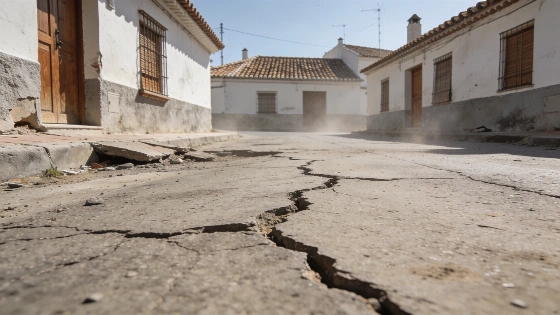
Granada’s metropolitan area experienced more than 20 earthquakes overnight. The strongest, magnitude 3.1, struck Armilla. Emergency services increased building inspections, but no major structural damage was found.
Granada’s metropolitan area faced a tense night as more than 20 earthquakes were recorded from midnight through early Sunday, according to the Instituto Geográfico Nacional. The strongest tremor, a magnitude 3.1 quake with its epicenter in Armilla, was felt at 4:40 a.m. at a depth of 7 kilometers. These seismic events followed a magnitude 4.8 earthquake in Alhendín just a day earlier, which had already prompted heightened alert and emergency measures across the province.
Most of the recent tremors were shallow, making them noticeable to residents in Armilla, Ogíjares, Gójar, La Zubia, Churriana de la Vega, and Alhendín. The intensity of the quakes ranged from 1.5 to 3.1, with ten of them clearly felt by the population. Emergency line 112 Andalucía received numerous calls from affected towns, but authorities confirmed there were no injuries or significant personal harm reported.
Another notable quake, measuring 2.8 in magnitude, struck Ogíjares at 6:27 a.m. Its effects were reported in several municipalities, including Alfacar, Maracena, Vegas del Genil, Cúllar Vega, Las Gabias, Alhendín, La Zubia, Cenes, and Huétor Vega. The Junta de Andalucía has kept the pre-emergency phase of its seismic risk plan active since the initial 5.0 magnitude event in Alhendín, reflecting ongoing concern about further aftershocks.
In response to the seismic activity, Granada’s city council has ramped up building inspections. Over 800 requests have been received, and firefighters have carried out 154 interventions so far. Preliminary assessments indicate that most buildings’ main structures have withstood the tremors well, with damage largely limited to non-structural elements. The mayor, Marifrán Carazo, urged calm and caution, emphasizing that widespread structural damage has not been detected. On Saturday, several homes on Marqués de Mondéjar and Alhamar streets were evacuated as a precaution.
Between 8:30 a.m. and 6:00 p.m. on August 15, the city’s fire and rescue service managed around 400 calls and performed 122 interventions related to unstable building elements. From Saturday afternoon until Sunday morning, firefighters responded to 150 requests and conducted 32 additional interventions. These efforts are part of a broader push to ensure public safety and address residents’ concerns in the wake of repeated tremors.
Regional authorities have warned that further seismic activity is likely in the coming days or weeks. The president of the Junta de Andalucía, Juanma Moreno, advised residents to remain vigilant and follow safety recommendations. He noted that, despite the anxiety caused by the recent earthquakes, there have been no fatalities or major incidents. Technical teams continue to monitor building safety, and no structures are currently considered at risk, though ongoing inspections will determine if further action is needed.
Granada’s location on active tectonic faults means that earthquakes are not uncommon. Civil Protection and the Instituto Geográfico Nacional have reiterated key safety advice: avoid elevators, stay away from windows and lamps, and remain calm during tremors. If outside, move to open areas away from buildings and infrastructure; if inside, seek shelter under sturdy furniture or next to a load-bearing wall. Residents are also reminded to cut off water, electricity, and gas supplies if necessary, and to use stairs rather than elevators during evacuations. Drivers should stop in a safe place, turn on hazard lights, and stay inside their vehicles until the shaking stops.
Spain’s varied geography makes it susceptible to different natural hazards. While Granada deals with seismic risks, other regions have recently faced severe weather, as highlighted in reports such as the recent coverage of storms and hail affecting northern and eastern Spain. These events underscore the importance of preparedness and coordinated emergency response across the country.
Granada’s experience serves as a reminder of the region’s vulnerability to seismic activity. The city’s rapid response, ongoing inspections, and clear communication from authorities have helped maintain public safety and minimize disruption. As aftershocks remain possible, local officials continue to prioritize monitoring and support for affected residents.