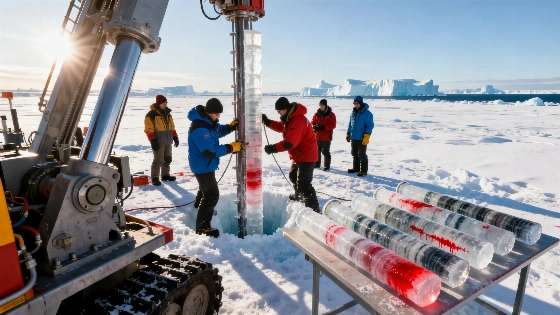
A new study finds that human mercury pollution began 4,000 years ago, not just with modern industry. Analysis of a deep Greenland ice core shows emissions linked to ancient mining and metallurgy.
Human impact on the environment stretches much further back than previously thought. An international research team, including scientists from the Instituto de Química Física Blas Cabrera (CSIC), has uncovered evidence that mercury pollution caused by human activity began at least 4,000 years ago. This conclusion comes from a detailed analysis of a Greenland ice core drilled to a depth of 1,250 meters, as reported in Science Advances.
The ice core, extracted as part of the East Greenland Ice-core Project, offers a unique record covering nearly the entire Holocene period—about 11,700 years. Each layer of ice preserves chemical traces from the atmosphere, capturing both natural events like volcanic eruptions and signals from human activities occurring thousands of kilometers away.
Until now, mercury contamination was mainly associated with the industrial era. However, the new data indicate that significant human emissions began during the Bronze Age. Researchers found that ancient practices such as copper and tin smelting, as well as the widespread use of cinnabar—a mercury-rich mineral used as a red pigment and for medicinal purposes—were already releasing mercury into the atmosphere. Archaeological findings from the Iberian Peninsula, where high mercury levels have been detected in human remains, support this hypothesis. The presence of mercury in the central Greenland ice core suggests that emissions from these early activities were substantial enough to affect the entire northern hemisphere's atmosphere.
The study also documents a steady rise in mercury accumulation in Greenland over the centuries. Levels doubled and then nearly tripled from the 13th century onward, with a dramatic increase—over sevenfold—after 1840, coinciding with the onset of the Industrial Revolution. The researchers were able to distinguish between mercury released by human activity and that from major volcanic eruptions, such as Iceland's Laki in 1783 and Alaska's Novarupta in 1912, thanks to the high temporal resolution of the ice core data.
Mercury is a toxic metal that can travel long distances in the atmosphere before settling in oceans and remote regions. Once deposited, it accumulates in marine food chains and can reach humans through the consumption of large fish like tuna. The findings from Greenland are expected to refine current emission models and inform international agreements such as the Minamata Convention, which has been in force since 2017 to protect human health and the environment from mercury pollution.
For context, mercury is considered one of the most dangerous environmental pollutants due to its persistence and ability to bioaccumulate. Even low levels of exposure can pose health risks, especially for pregnant women and children. The discovery that human-driven mercury emissions began millennia ago highlights the long-term legacy of mining and metallurgy, and underscores the importance of ongoing efforts to monitor and reduce mercury release worldwide.