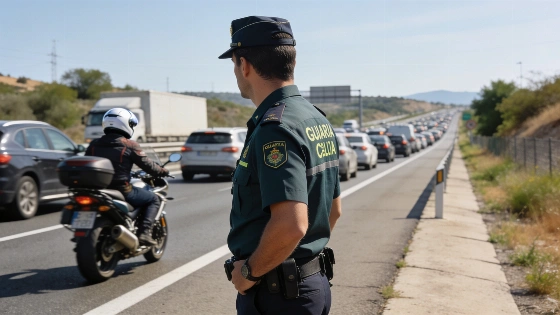
Spain’s new traffic regulation allows motorcycles to ride on the hard shoulder during congestion, but the Guardia Civil has made it clear they will not monitor the 30 km/h speed limit set by the DGT. This gap between law and enforcement leaves riders and drivers facing new uncertainties.
Motorcyclists in Spain just got something they have wanted for years. They can now ride on the hard shoulder during traffic jams, but only if the road is marked for it and the traffic is heavy enough. The real shock is not the rule itself. It is the Guardia Civil’s blunt refusal to enforce the 30 km/h speed limit set by the Dirección General de Tráfico (DGT).
From October 1, 2026, Spanish motorcyclists will also be required to wear gloves on intercity roads and closed footwear on all roads, as part of a broader package of DGT reforms.
Not everyone is happy. Many drivers worry about safety, especially if they have to stop on the shoulder in an emergency. The DGT tried to address this by setting a strict 30 km/h speed limit for motorcycles on the shoulder. They want to cut risks for everyone. Official explanations keep repeating this limit. There is also a rule that motorcycles must ride single file, not in groups. La Razón and TraficoTest both highlight these safety steps.
But the reality is different. Agents from the Comisión de Tráfico de AUGC (Asociación Unificada de Guardias Civiles) have said, “nadie va a controlar que los motoristas vayan a 30 kilómetros/hora.” No one will check if riders stick to the speed. Fixed speed cameras only watch the main lanes. The Guardia Civil will not post officers just to monitor this rule. Several Spanish publications confirm this. The gap between the law and what happens on the road is wide.
The new regulation is not a blanket permission: motorcycles may only use the hard shoulder in traffic jams and only on stretches specifically marked with signage. Headlines suggesting universal access are inaccurate, as confirmed by multiple Spanish sources.
Motorcycle accident rates in Spain are already high. No one knows if this new rule will help or hurt. The Guardia Civil’s position makes the 30 km/h limit more theory than fact. The rule is on paper. On the road, little will change. Until enforcement catches up with the law, riders and drivers are left guessing. The rules are clear. The consequences are not.