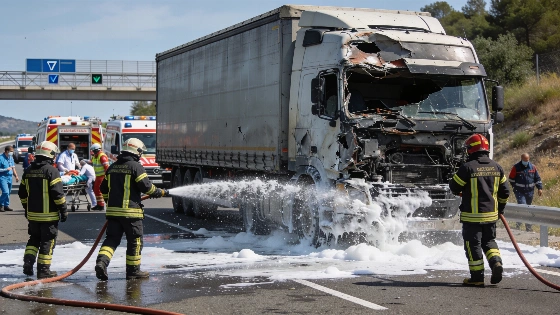
A truck carrying hazardous chemicals veered off the A7 near Cox, injuring three and prompting a rapid emergency operation to contain a dangerous resin leak. Authorities activated a special safety plan to prevent further risk.
Firefighters covered the road with foam early Thursday morning after a truck carrying hazardous chemicals crashed off the A7 near Cox. Three people were injured, and emergency crews moved quickly to contain a leaking resin spill and prevent further danger.
The truck, loaded with chemical compounds and resin, lost control at kilometer 546 heading toward Murcia. According to the Consorcio Provincial de Bomberos de Alicante, the cargo began leaking onto the road, raising concerns about fire and environmental damage. Fire crews used foam to stop the resin from spreading and to reduce the risk of ignition. A command unit, heavy urban pump, and rescue van were sent from Orihuela, staffed by a sergeant, a corporal, and six firefighters. The crash happened at about 08:41 near the Redován exit in Cox, according to official reports.
The Generalitat Valenciana’s emergency coordination center activated level 1 of the Special Plan for Hazardous Goods due to the risk of fuel and hazardous substance spillage.
Medical teams arrived within minutes. The 55-year-old truck driver had multiple injuries and was stabilized before being taken by the Servicio de Ayuda Médica Urgente (SAMU) to Hospital de la Vega Baja. Two women in other vehicles were also hurt: one had abrasions and a leg injury, and the other, age 24, was treated for a neck sprain. Both were taken to the same hospital by basic life support and non-assisted transport units. All three received prompt medical care, which helped prevent more serious harm.
The Generalitat Valenciana’s emergency center escalated the response by activating level 1 of the Special Plan for Hazardous Goods. This protocol is used for incidents that can be managed with available resources but still require extra steps to protect people, property, and the environment from chemical risks. The plan was triggered because of the fuel spill risk, as confirmed by the agency on social media. Both Todo Alicante and Europa Press noted that the quick work by emergency services was key in preventing a fire and more serious environmental damage.
Accidents involving hazardous cargo are not uncommon on Spanish roads, but the fast response in Cox kept the situation from becoming much worse. In a similar case reported earlier, emergency teams faced similar challenges when vehicles carrying dangerous loads crashed, showing how important rapid intervention and specialized protocols are in these situations.
The emergency response in Cox involved a command and control unit, a heavy urban pump, and a rescue van from Orihuela, with a team consisting of one sergeant, one corporal, and six firefighters. The quick localization of the spill was repeatedly emphasized by independent sources as key to averting a larger disaster.
As noted by Google/SpainAuto, the coordinated response in Cox shows the value of strong emergency planning and cooperation between agencies when hazardous materials are involved. Even routine transport routes can become dangerous in seconds, and there is little room for error when chemicals are on the road. For Spain’s transport sector, the lesson is clear: being prepared and acting quickly are the best ways to prevent disaster.