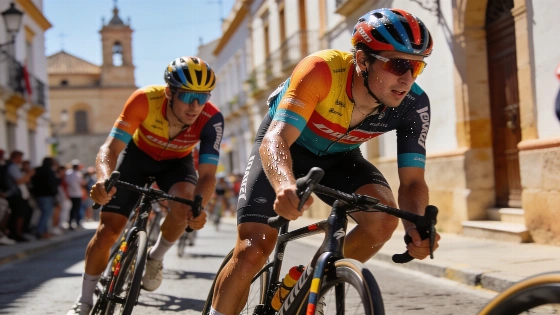
Organizers cut nearly 80 kilometers from La Vuelta’s fifteenth stage due to extreme heat. The revised route in Córdoba now promises a relentless battle. Enric Mas enters the day as the reinforced leader.
La Vuelta 2026 took an unexpected turn when organizers cut almost 80 kilometers from stage fifteen, citing dangerous heat across Córdoba province. The decision, announced late Saturday, turned what was meant to be a long endurance stage into a condensed, high-pressure race of just 110.2 kilometers. Race officials said the change followed activation of the extreme weather protocol and discussions with commissaires, teams, and riders, all focused on protecting athlete health and keeping the competition safe.
With the new route, riders now face a series of climbs and descents, with only the start and finish offering any flat ground. The original loop around Villaviciosa de Córdoba is gone, forcing teams to rethink their plans overnight. The stage still starts in Palma del Río and ends in Córdoba’s Plaza de la Constitución, but now includes a string of third-category climbs and technical descents. According to Domestique Cycling, the revised course keeps the opening kilometers before diverting at kilometer 52 to avoid the most exposed section.
The neutralized start was rescheduled to 14:50, with the official race start at 15:00 local time, to help riders avoid the peak of the afternoon heat.
Enric Mas, who built his lead in the mountains, comes into this shortened stage with momentum but also new risks. The route now features the La Forestal and Atarfi climbs, the latter just 35 kilometers from the finish, followed by sharp ramps and a fast descent into the city via Avenida del Brillante. The final kilometer includes a tight 90-degree turn and the San Rafael bridge, a section known for its unpredictability—Wout van Aert won here two years ago. The original stage had 3,130 meters of climbing and included Alto del Villaviciosa de Córdoba and Puerto de Artafi, but the new route cuts some of these, as noted by Olympics.com and other cycling analysts.
Television Española and RTVE Play will broadcast the stage live from 14:45 Spanish time, with Carlos de Andrés and Perico Delgado on commentary. Coverage also runs on RNE and TDP Noticias, and Teledeporte’s social media will share interviews and highlights throughout the day. Fans can follow the action across platforms as the race adapts in real time.
This is the twenty-second time Córdoba has hosted a La Vuelta stage finish, adding to its reputation as a classic test for the peloton. The city’s narrow streets and sudden gradients have challenged top riders before. With the route now shortened by heat, teams face a more explosive contest and little margin for error.
Forecasts indicated temperatures of 39–40°C in Córdoba and Andalusia on the day of the stage, prompting the activation of the extreme weather protocol. This drastic shortening of the route reduced the long rolling terrain and shifted the stage dynamic toward short, explosive racing, as noted by several cycling analysts.
Last-minute changes like this aren’t new in elite cycling, but the scale of this cut stands out. The organizers’ choice to put rider safety first over tradition shows a practical shift in how major sports events handle extreme weather. Similar rapid changes have happened in other competitions, as reported earlier during recent climate emergencies in Spain.
With a rest day coming up, today’s stage could shake up the general classification and reveal any weaknesses among the leaders. The compressed format leaves little time to recover, and the technical finish in Córdoba could reward bold moves or punish hesitation. The organizers’ quick response highlights a new reality for Spanish sport: adaptation is now as important as tradition. La Vuelta’s willingness to change course in the face of adversity may set a precedent for future editions and for any event facing the realities of a changing climate.