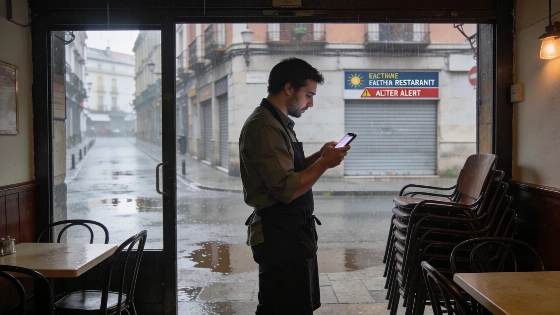
A new protocol guarantees hospitality workers up to four days of paid leave if a red alert makes travel unsafe. The rule, now part of national labor law, requires employers to honor official warnings and protects staff from penalties when authorities restrict movement.
Hospitality workers in Spain no longer have to choose between their safety and their paycheck when a red alert stops travel. As of September 4, employees covered by the Acuerdo Laboral Estatal de Hostelería can take up to four days of paid leave if official warnings or restrictions make it dangerous or impossible to get to work. This right is tied directly to article 37.3(g) of the Estatuto de los Trabajadores, which protects workers when authorities issue travel bans or severe weather alerts.
The rule is clear and enforceable. Article 37.3.g of the Estatuto de los Trabajadores gives it legal weight. Employers must follow the latest official alert issued before each shift, even if it comes outside regular update hours. If authorities ban travel or declare an imminent risk, the worker’s absence is justified and fully paid for up to four days. The protocol is part of the ALEH VI agreement and took effect on September 4, 2026, covering an estimated 1.2 million hospitality employees.
For staff, the steps are straightforward: once they receive an official notice that travel is unsafe or forbidden, they must inform their employer as soon as possible and keep the documentation. They are not expected to try to reach work against explicit warnings. Employers can ask for proof, but cannot override the authorities or penalize staff for following official instructions. Labor unions and legal experts confirm that workers cannot be sanctioned, required to make up hours, or face discipline for justified absences under article 37.3(g).
Companies must now assess risks at each location, especially in flood-prone areas. This means planning for safe evacuation and taking steps to reduce exposure to extreme weather. For outdoor workers or those in venues that cannot close, employers must protect staff from hazards like heatwaves or storms. The paid leave protocol is a last resort, not a replacement for proper safety planning. Official guidance stresses that this measure does not replace standard occupational safety rules, but acts as a fallback when risks cannot be controlled.
The protocol is simple: the most recent official alert before a shift determines what happens. If the risk level drops and authorities lift restrictions during a shift, staff are expected to return when it is safe. Both employers and employees must rely on official communications, not forecasts or speculation.
Disputes over absences or dismissals related to red alert leave are subject to strict legal review. Workers have twenty business days to challenge a dismissal, and documentation from the alert is key evidence. As stated in the official BOE, the protocol is now part of national law.
This change goes beyond paperwork. It sets a clear standard for employers who might otherwise pressure staff to ignore safety warnings or risk their jobs. By linking paid leave directly to official alerts, the protocol removes uncertainty and puts responsibility on management to respect public safety. In a sector where working conditions are often unstable, this is a rare example of the law firmly supporting workers’ rights and wellbeing.