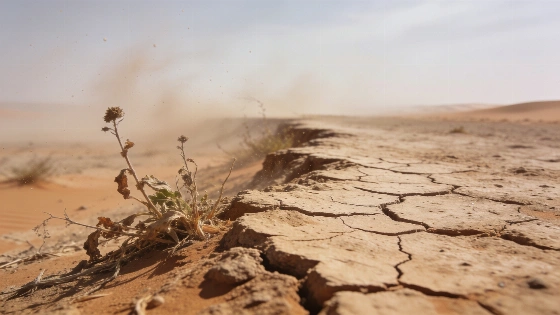
A dramatic drop in rainfall swept across North Africa 5,500 years ago, transforming green landscapes into desert. Scientists now trace a key trigger to a cooling event near Greenland, revealing how distant climate shifts can reshape entire continents.
About 5,500 years ago, the Sahara shifted quickly from green grasslands to desert. The cause wasn’t local. New research points to a cold spell near Greenland that set off a chain reaction across Africa’s climate.
Marine sediment cores from the Gulf of Guinea show rainfall in the region dropped sharply between 5,800 and 4,800 years ago. Chemical markers in ancient plant waxes—specifically hydrogen isotopes—reveal a sudden, severe decline in precipitation. The biggest drop happened around 5,300 years ago, matching other records from eastern North Africa and the rapid shrinking of ancient Lake Mega-Chad.
Climate simulations indicate that surface temperatures in the northeast Atlantic dropped by up to 2.5°C during the key cooling event, enough to disrupt wind and moisture circulation across Africa.
Remote triggers, local collapse
What set off such a dramatic change? A 2017 study in Nature Communications traced the end of the African Humid Period to a cooling episode in the North Atlantic. Temperature records from Greenland, the Norwegian Sea, and the Fram Strait show this cold anomaly. It weakened the tropical easterly jet—a wind system that pulls monsoon rains deep into Africa. As the jet lost strength, the monsoon’s reach shrank, and the Sahara began to dry out.
Simulations suggest the cooling may have been caused by changes in ocean currents or a larger polar vortex. The study used a hypothetical influx of freshwater to test the system, not as a literal explanation. The result was a surface temperature drop of up to 2.5°C in the northeast Atlantic, enough to disrupt the winds and moisture that once fed North Africa’s rivers and lakes. Recent summaries in science outlets note that new sediment and isotope data from the Gulf of Guinea directly link the timing of rainfall collapse to this North Atlantic cooling event.
Feedback loops and irreversible change
Once the rains weakened, the land itself sped up the drying. As vegetation disappeared, the soil lost its ability to hold moisture. Bare ground reflected more sunlight and released less humidity. Dust storms grew worse, and shrinking lakes dried the region further. These feedbacks didn’t start the process, but they made recovery impossible after a certain point.
The rapid aridification of the Sahara between 5,800 and 4,800 years ago is now directly linked to a sharp decline in monsoon rainfall, as confirmed by marine sediment records from the Gulf of Guinea. This evidence supports the view that remote climate events, such as North Atlantic cooling, can trigger abrupt environmental changes across entire continents.
The study doesn’t blame a single cause. Greenland’s cooling was a trigger, not the only factor. The Sahara’s desertification came from the interaction of ocean, atmosphere, vegetation, and dust, all responding to a relatively small shift in northern temperatures. The change wasn’t even across the region; some areas dried out faster than others, and the process took centuries.
Lessons for a changing world
This research shows that climate events in one part of the world can have major effects far away. The planet’s systems are tightly connected, and even small changes in ocean circulation or polar conditions can ripple across continents. Similar patterns have appeared in other periods of rapid climate change, as seen in previous research on environmental adaptation.
Today, projects like Africa’s Great Green Wall—a massive reforestation effort—aim to reclaim land lost to desertification. But the Holocene record is clear: once certain thresholds are crossed, reversing ecological collapse becomes much harder. The Sahara’s story is not just ancient history; it’s a warning about how distant climate shifts can redraw entire regions. As global temperatures and ocean currents keep changing, the forces that once dried the Sahara are still in play—and still unpredictable.