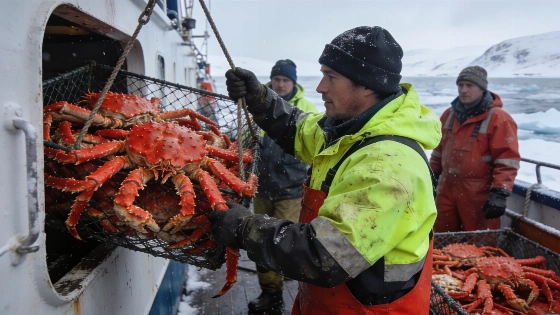
In 1961, Soviet scientists released thousands of red king crabs into the Barents Sea, hoping to create a new fishing industry. Decades later, the species has transformed the region’s marine life and become a lucrative export for Norway, but at a lasting environmental cost.
In 1961, Soviet researchers released 1.5 million red king crab larvae into the waters near Murmansk, launching one of the most ambitious marine introductions of the Soviet era. Over the next eight years, they added 10,000 juvenile and 2,609 adult crabs from the Pacific, aiming to establish a new fishing resource in the Barents Sea. For years, the project seemed to yield little, with few sightings and doubts about its success.
But beneath the surface, the crabs were adapting. By 1974, the first specimens were caught near Murmansk, and soon after, they began appearing in Norwegian waters. The population quietly expanded, eventually spreading more than 430 kilometers westward along the northern Norwegian coast, according to tagging studies. The species’ ability to thrive in new conditions, combined with a broad diet of mollusks, worms, and other seabed creatures, allowed it to reshape local ecosystems wherever it settled in high numbers.
Economic Boom, Ecological Cost
What began as a Soviet experiment has become a major economic force. In 2025, Norway exported 1,844 tonnes of red king crab, earning 1.2 billion Norwegian kroner—the highest annual value on record. The catch is now a prized commodity for both Russia and Norway, with key markets in the United States, Canada, and Vietnam. More than a thousand Norwegian vessels were licensed to fish for the species in quota-managed areas in 2026, reflecting the scale of the industry.
Yet the commercial success comes with a price. Scientific studies have documented significant changes to benthic communities and sediment quality in areas where crab densities remain high. The red king crab’s appetite and adaptability have altered the balance of marine life on the Barents Sea floor, raising concerns about long-term ecological impacts. The case highlights how introducing a non-native species—even for economic reasons—can permanently transform an ecosystem.
From Pacific Origins to Arctic Waters
The crabs originally came from the Bay of Peter the Great in the Sea of Japan and the southwestern coast of Kamchatka in the Sea of Okhotsk. Early Soviet attempts to introduce the species in the 1930s failed, but the 1960s effort succeeded, thanks to the scale and persistence of the releases. While the operation is often summarized as the introduction of 12,000 crabs, the true numbers were far higher when including larvae.
For years, the lack of visible results led many to believe the project had failed. In reality, the crabs were slowly establishing themselves, and once acclimated, their spread was steady and difficult to reverse. Some individuals have been tracked moving far beyond the average annual range, underscoring the species’ mobility and resilience.
Managing a Profitable Invasive Species
Today, the red king crab is both a valuable resource and a persistent ecological challenge. Norwegian authorities now manage the fishery through quotas and licensing, balancing economic interests with environmental concerns. The long-term effects on native species and seabed habitats remain under study, but the transformation is already evident in many areas.
Sixty-five years after the first release, the Barents Sea stands as a testament to the unintended consequences of human intervention. The region now supports a thriving fishery, but also bears the mark of a decision that permanently altered its marine landscape.