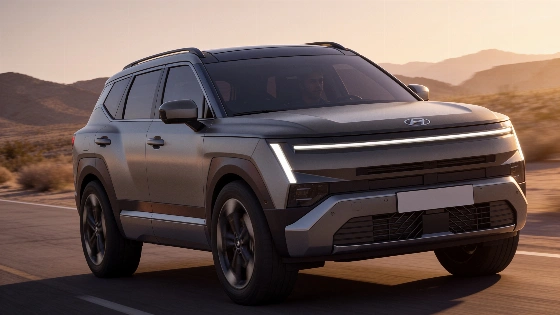
Hyundai has revealed a completely redesigned Tucson, now nearly 20 cm longer, with a bold, angular exterior, a 17-inch touchscreen, and a fully electrified engine range. The new model leaves its old design behind and signals Hyundai's push into the next era of SUVs.
Hyundai has taken a new direction with the latest Tucson, dropping the familiar curves of its best-selling SUV for a boxier, more upright shape and a full commitment to electrified engines. Diesel is gone for good.
The fifth-generation Tucson now measures 4.70 meters long—almost 20 centimeters more than before—putting it close to the size of the seven-seat Santa Fe. The wheelbase stretches to 2.79 meters, which means more room inside, especially in the back. Rear headroom is up by 29 millimeters, and the back doors open wider, making it easier to get in and out.
The official debut of the new-generation Hyundai Tucson is scheduled for August 19, 2026, with sales in South Korea starting in the fourth quarter of 2026 and global markets following in 2027.
The changes are obvious at first glance. The Tucson now has a high, flat hood, a large rectangular grille, and H-shaped LED lights front and rear. The rounded lines of earlier models are gone. Hexagonal wheel arches and a floating roofline add to the geometric look, and the overall stance hints at a tougher, more off-road-ready SUV—even though not every version will have four-wheel drive.
Inside, Hyundai has reworked the cabin with a focus on tech and usability. The twin screens from the last model are replaced by a digital instrument cluster and a large 17-inch central touchscreen. Physical buttons are back for climate, audio, and seat controls, which should please drivers who dislike touch-only setups.
The new Pleos Connect system, built on Android Automotive, brings real-time over-the-air updates and a virtual assistant powered by generative AI. Hyundai aims to keep the Tucson's tech up to date for years to come.
According to recent industry reports, the new Tucson will be offered exclusively with a 1.6-liter turbocharged petrol engine and a hybrid version based on the same engine, with the hybrid producing around 242–245 hp and 380 Nm of torque. Certified fuel consumption figures for the hybrid are approximately 5.7–5.8 L/100 km, while the petrol version is rated at about 8.2 L/100 km.
The biggest change is under the hood. Hyundai has dropped diesel engines entirely, offering only electrified options. The lineup starts with mild-hybrid petrol engines, moves up to self-charging hybrids, and will include a plug-in hybrid expected to deliver over 100 kilometers of electric-only range thanks to a higher-density battery.
For buyers who want a tougher look, the XRT version adds off-road-inspired styling and extra body protection, though this does not mean all-wheel drive is standard.
The new Tucson will launch first in Korea, and its size is tailored to that market. Korean versions are usually longer than European ones, so buyers in Spain and elsewhere may see a slightly shorter model when it arrives.
Hyundai has sold more than three million Tucsons worldwide in the past six years. This redesign is a big gamble, but it follows the same pattern as other brands that have shaken up their bestsellers—like Citroën's recent Holidays Max camper, as reported earlier.
Hyundai's move away from diesel and toward electrification is more than just a response to regulations. The brand wants to set the pace for mainstream SUVs. The new Tucson's size, technology, and bold design raise the bar for the segment. The real verdict will come when European drivers get behind the wheel.