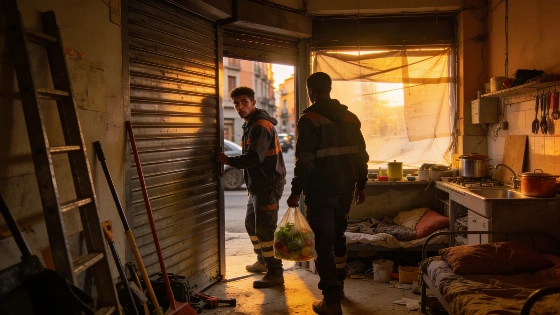
Moroccan Migrants Forced to Live in Former Shop Due to Housing Shortage. In northern Barcelona, five migrants from Morocco have turned a former butcher shop into their home. With affordable apartments in short supply, they are forced to hide and pay rent for a storage space. Their stories highlight the scale of the housing problem faced by migrants in Spain.
In the northern part of Barcelona, five young migrants from Morocco, including two construction workers — Abdel and Omar — have been forced to live for almost two years in a former halal butcher shop. Unable to rent legal housing, they sublet this commercial property from a Spanish owner for 700 euros per month, officially as a warehouse for building materials. In reality, the premises have become their only shelter, where they have to hide from prying eyes and constantly fear eviction.
Life behind closed curtains
The entrance to the former shop is carefully disguised: the metal shutter is lifted only for a moment, the doors are covered with aluminum, and the windows are always curtained. Inside, there are makeshift rooms built from discarded furniture and an improvised kitchen at the back. Abdel, 27, sleeps closest to the door, while Omar, 29, is separated from him by an old wardrobe. Both work in construction, earning around 1,600 euros a month, but even the simplest apartment is out of reach: options on the market are extremely limited, and agencies do not respond to their inquiries.
Unaffordable housing and the rental market
According to Abdel, even with a stable income and documents, it is almost impossible to rent accommodation. On popular portals like Idealista, there are only a few apartments available in their area, and just two of them cost less than 800 euros. Omar says he is willing to pay up to 600 euros, but believes his Moroccan background only makes the search harder. Both men came to Spain from the city of Al Hoceima in northern Morocco, arriving by boat, and now dream of bringing their wives here. However, to apply for family reunification, they need official housing with the required paperwork, but their current shelter does not even have a basic "cédula de habitabilidad."
Registration issues and the padrón market
Officially, Abdel and Omar are registered not at their actual place of residence, but in someone else’s apartments. This service comes at a price: Abdel paid 500 euros to a neighbor from Latin America to obtain his registration, and now, as he needs to renew his documents, prices on the registration market have risen to 1,000 euros. Omar managed to register for free with a relative. Municipalities are tightening controls on registration, fearing fraud, but often overlook the fact that migrants are forced to seek workarounds because it is impossible to legally rent a home.
The invisible side of migration
The story of Abdel and Omar is just one of many where migrant workers employed in construction and renovation are themselves left without access to decent housing. Their daily lives are marked by constant anxiety: they only return home at night, cook on an improvised kitchen, wash up, and go to bed without knowing what is happening behind the drawn curtains. Omar admits he feels isolated and deprived of security. According to research, such cases of 'infravivienda'—living in premises not intended for housing—are becoming increasingly common in Spanish cities.
The problem of access to housing for migrants and the related bureaucratic barriers are not limited to Barcelona. In other regions of the country, as shown by a recent case when a family could not be evacuated from Gaza due to bureaucracy and closed borders, the issues of legalization and residence remain highly relevant—read more in the article about the tragedy of the family unable to leave the Gaza Strip: a story of a failed attempt to evacuate from Gaza.