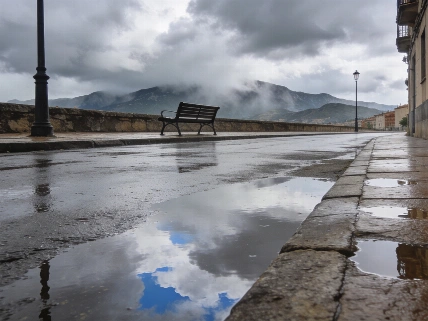
Catalonia Assesses Damage After Mass Tree Fall in Forests. Strong winter winds in Catalonia have toppled thousands of trees. In Ripollès, the damage is three times higher than usual. Authorities are working on measures to prevent pest outbreaks and reduce fire risks.
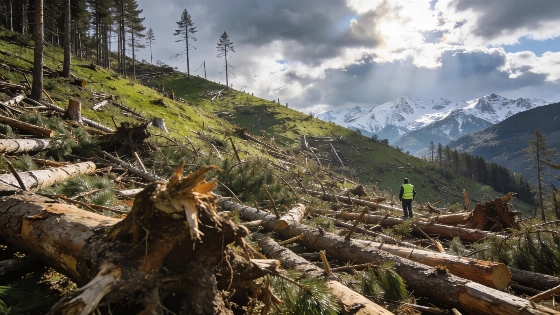
In Catalonia, after the winter storms, authorities and forestry services have faced an unprecedented level of destruction: in Ripollès alone, 23,500 tons of timber fell in just a few days—three times the region's annual volume. The strongest winds, reaching 120–200 km/h, swept across several comarcas, including Maresme, Montsià, Gironès, Alt and Baix Empordà, but Ripollès bore the brunt of the aftermath. In some areas, locals compare the scene to a 'post-war zone.'
Threat of pests and fires
The main challenge now is to prevent a mass outbreak of bark beetles and reduce the risk of forest fires. According to the Consorci d’Espais d’Interès Natural del Ripollès (CEINR), restoring the roads alone will require about 130,000 euros. The Generalitat is assessing the damage and preparing support measures for municipalities and private forest owners. In total, 312 hectares of forest were affected, mostly fir, and in some places, such as Vilallonga de Ter, almost 100 hectares were destroyed.
Geography of the destruction
Beyond Ripollès, significant losses were also recorded in cities and suburbs: around a hundred trees fell in Mataró, a similar number in Girona, about 50 in Platja d’Aro, 30 each in Begur and Palamós, and 20 in Figueres. In Campelles, 86 hectares were damaged, in Ribes de Freser 36, and in Planoles 33. A disaster of this scale has been recorded only once before—in 2008, when a 'column of air' destroyed forests in Ribes and Campelles.
Causes and consequences
Experts attribute such large-scale consequences to a combination of factors: moist soil after rainfall, shallow roots on slopes, and 'wet snow' that breaks branches and weakens trees. According to the Forest Science and Technology Centre of Catalonia (CTFC), forest vulnerability is exacerbated by the lack of regular maintenance: two-thirds of the region's forests are unmanaged, and 76% of the territory is privately owned.
Dilemma: remove or leave the timber
In Ripollès, some of the fallen trees are in public forests, and their removal will be organized through special auctions coordinated by the Generalitat. It is important to sell the timber before it loses value. In hard-to-reach areas, such as Bac d’Abella, new access routes will need to be built. For small municipalities, such as Vilallonga de Ter with a population of 400, income from timber sales can provide significant support.
However, experts note that leaving large amounts of dead wood in the forest can lead to pest outbreaks, although in moderate volumes it supports biodiversity and helps prevent the spread of fire. In Ripollès, the risk of wildfires is considered moderate, but if the summer is dry the situation could change.
What's next
There is no universal solution for all affected areas: in some places, the priority is clearing roads and infrastructure, while elsewhere, it is preserving the ecosystem. Authorities point out that it is impossible to entirely avoid the consequences of extreme winds, but proper forest management can reduce vulnerability. Experts advise against artificial restoration, recommending instead to let nature recover on its own, with a focus on mixed-age and mixed-species forests.
The issue of natural disaster impacts on infrastructure and the environment is becoming increasingly relevant for Spain. Recently, after a major fire in Burgos, authorities were forced to urgently change transport routes and wait for specialists from Madrid — details on the municipal transport situation in Burgos.