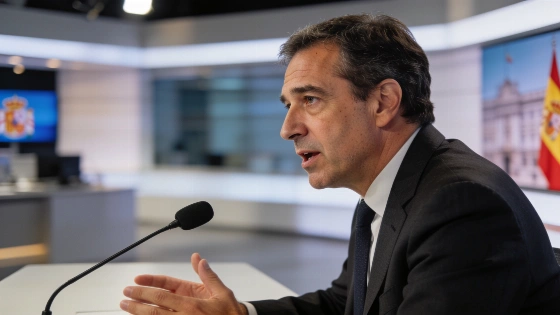
Isabel Rodríguez’s week as Spain’s housing minister unraveled after two key decrees failed and a high-profile eviction reignited scrutiny of her record. Her personal property holdings and political trajectory now face sharper public examination.
Spain’s housing ministry hit a wall this week. Isabel Rodríguez, the minister in charge, watched as two major housing decrees fell apart in Congress. Her grip on the ministry slipped. The trigger? The eviction of Maricarmen Abascal, an elderly tenant in Madrid’s El Retiro. Her case had dragged on for months. Suddenly, it exploded into a national flashpoint. Rodríguez was left scrambling to defend her policies as the crisis unfolded in real time.
On October 2, 2026, Spain's Congress rejected both government housing decrees, with the first failing 178 to 172 and the second 184 to 166.
Rodríguez lashed out at Urbagestión, the owner of Abascal’s flat. She called it a “pyme buitre, muy buitre, muy carroñera.” The facts tell a different story. Urbagestión is a small company. It owns just one residential property. It had already reached a deal with Madrid’s city council. Abascal could return, paying 30% of her pension. Meanwhile, Rodríguez owns three properties. That’s twice as many as Urbagestión. She bought them in 2004, 2011, and 2018. Two are co-owned. The third is in her name alone. Her annual rental income is 5,130 euros. She also has three mortgages with large outstanding balances.
Rodríguez’s political career started early. At 22, she became Spain’s youngest senator in 2004. That same year, she bought her first home in Puertollano, a 110-square-meter flat. She moved through regional and national posts: director of Castilla-La Mancha’s youth institute, regional government spokesperson, three terms as a deputy in Congress, and a short stint as mayor of Puertollano. She never backed Pedro Sánchez in PSOE primaries. Instead, she supported Madina and Susana Díaz. Sánchez only brought her into the cabinet in 2021. First, she served as Minister of Política Territorial. Then, she became government spokesperson. In 2023, she took over the housing ministry.
The rejected decrees included measures on evictions, rental contracts, and restrictions for buyers and investment funds. According to BBC and Reuters, the failure of these packages increased pressure on the Sánchez government and raised the prospect of early elections, as the coalition's survival now depends heavily on Junts, who voted against the proposals despite last-minute negotiations.
Some political insiders say Rodríguez’s path has been sheltered. She held “comfortable, visible posts and few real responsibilities.” Her time as mayor was short. Madrid’s national stage has been much tougher. The failed decrees and the Abascal eviction have raised doubts about her skills and instincts. The criticism is growing louder.
Rodríguez has called housing “the greatest problem facing Spanish citizens.” The numbers are stark. Her own ministry’s data shows the Sánchez government ranks last in subsidized housing delivery since 1981. Only 78,735 units were finished between 2018 and 2025. That’s just 3.2% of the total built in the last forty years. The yearly average is 9,842 units. No other administration in recent democratic history has done worse. Rajoy, Zapatero, Aznar, and González all built more. Since 2018, three different ministers have led the housing ministry. Rodríguez only took over in late 2023, after the ministry became independent again.
Now, her property holdings, financial disclosures, and family ties are under the microscope. Her image has shifted. In Abenójar, she’s still a familiar face. In Madrid, the pressure is intense. The margin for error is razor thin.
The government’s housing policy is faltering. Public patience is running out. Rodríguez’s future in the cabinet is on shaky ground. The fallout from this week’s failures mirrors the wider instability on Spain’s left. Leadership struggles, like those reported earlier, add to the tension. For now, Rodríguez’s story is a warning. Political ambition can crash hard against the realities of government and public demand.