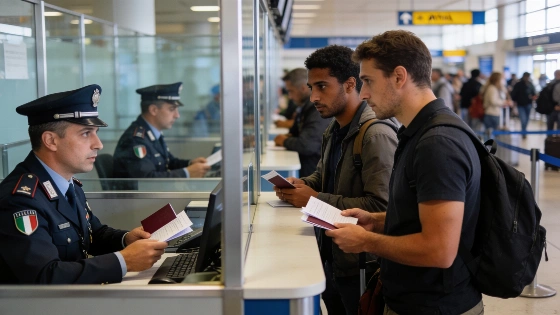
Italy will keep strict controls for travelers from Spain until mid-August. The government cites terrorism risks after the recent Ceuta migration wave. Spanish authorities criticize the move, calling it disproportionate.
Italy has confirmed it will continue extraordinary border checks for passengers arriving from Spain at least until August 15, citing heightened security risks linked to the recent mass entry of migrants into Ceuta. The decision, which has drawn sharp criticism from Spanish officials, is rooted in concerns over both terrorism and irregular migration, according to statements from Italian Foreign Minister Antonio Tajani.
Rome’s stance follows a surge of arrivals in Ceuta at the end of July, with Italian intelligence warning that up to 50,000 more migrants could attempt to cross into the Spanish enclave around mid-August. Tajani emphasized that the current situation does not allow Italy to relax its controls, referencing the possibility of terrorist threats and the need to prevent further irregular entries. He stated that the suspension of Schengen rules would remain in place until the perceived risks subside, after which Italy would be ready to restore previous arrangements.
The Italian government maintains that Madrid is also aware of the risk of another large-scale migration attempt before August 15, despite Spanish authorities not publicly expressing such concerns. Tajani described the continued controls as a precautionary measure and criticized Spanish Prime Minister Pedro Sánchez for what he called an exaggerated response to the situation. He also labeled Spain’s reaction to Italy’s measures as “incomprehensible and unacceptable,” especially after Spain imposed similar checks on travelers from Italy.
In addition to defending the border controls, Tajani renewed criticism of Spain’s migration policy, arguing that Madrid’s approach of regularizing large numbers of migrants sends a negative message and undermines security. The Italian government’s decision is based on an intelligence report, cited by Il Corriere della Sera and other Italian media, which points to a concrete risk of jihadist terrorism in the region. The report, reportedly compiled with input from Spanish intelligence, highlights the potential for 30,000 to 50,000 migrants to enter Ceuta between August 10 and 15, and notes the area’s history of cross-border extremist activity.
Italian authorities are also monitoring social media and messaging platforms, where they have detected coordinated efforts to organize another mass entry into Ceuta. Groups managed from Morocco, the United States, Egypt, Tunisia, Libya, and Senegal have been identified, some involving people smugglers who may exploit the situation to facilitate irregular crossings into Europe. Since the introduction of the controls on August 1, Italian officials have intercepted around twenty non-EU nationals from Morocco, China, Colombia, and Georgia with irregular documentation or legal issues. Fifteen were denied entry, while four were detained due to criminal records or pending legal proceedings. None had previously passed through Ceuta.
The ongoing dispute between Rome and Madrid over border controls comes amid broader political tensions surrounding the Ceuta crisis. As reported in a related development, Spanish opposition parties have called for a political trial against Prime Minister Sánchez over his handling of the border situation, highlighting the growing pressure on both governments. For more on the political fallout, see the recent coverage of the parliamentary initiative targeting Sánchez’s response to Ceuta: Congress debates Sánchez’s management of the Ceuta border crisis.
Ceuta, a Spanish autonomous city on the North African coast, has long been a focal point for migration flows from Africa to Europe. The city’s unique position, bordering Morocco, makes it a frequent entry point for those seeking to reach the EU. The current measures reflect ongoing challenges in balancing border security, migration management, and international cooperation within the Schengen Area. The situation remains fluid, with both Italian and Spanish authorities under scrutiny for their respective approaches to migration and security in the region.