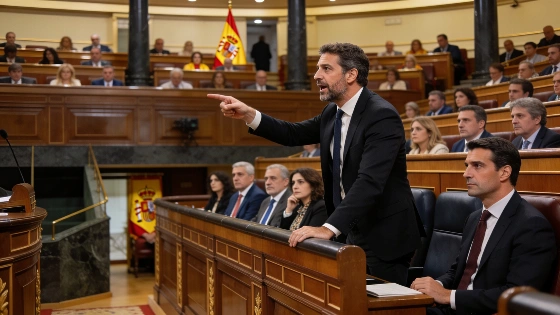
Santiago Abascal calls for Congress to initiate a political trial against Pedro Sánchez. The move targets the government's handling of the Ceuta border incident. Vox needs PP support to activate Article 102.
Santiago Abascal, leader of Vox, has formally urged Congress to launch a political trial against Prime Minister Pedro Sánchez, invoking Article 102 of the Spanish Constitution. The proposal, announced on social media, comes in response to the recent mass entry of migrants into Ceuta and accuses Sánchez of betraying national interests. Abascal claims the government had prior knowledge of the incident, which saw 72,000 people cross into the Spanish enclave, and argues this constitutes grounds for criminal responsibility.
The mechanism Abascal seeks to activate is unprecedented in Spain, though it is common in some Latin American countries. Article 102 allows the Supreme Court’s Criminal Chamber to judge the president or ministers for crimes such as treason or offenses against state security, but only if Congress initiates the process. To do so, a motion must be signed by at least a quarter of deputies—88 out of 350—and then approved by an absolute majority, or 176 votes, following a parliamentary debate that effectively serves as a political trial.
Vox, with just 32 deputies after Javier Ortega Smith’s move to the Mixed Group, lacks the numbers to present the initiative alone. The party’s only path forward is to secure support from the Partido Popular (PP), which currently shows little appetite for such a drastic measure. The PP has not even backed a motion of no confidence against Sánchez, making their endorsement of a political trial highly unlikely. Abascal’s call appears aimed at regaining momentum for Vox after the party failed to take a leading role in the Ceuta protests, where local outrage over the border situation has been high.
The accusation centers on the claim that Sánchez’s government was aware in advance of the mass crossing into Ceuta, a point the executive denies and for which no concrete evidence has been presented. The timing of the announcement—on a Saturday night in August—suggests a strategic move to capture attention during a period of political tension. While the practical chances of the initiative advancing are slim, it positions Vox as the only party openly demanding criminal proceedings against the prime minister, potentially consolidating its support among right-wing voters.
For context, the use of Article 102 has never been attempted in Spain’s democratic history. The procedure is designed for extreme cases involving crimes like treason or serious threats to state security, and its activation would mark a dramatic escalation in parliamentary confrontation. The Spanish Constitution sets a high bar for such actions, reflecting the gravity of removing a sitting head of government through criminal proceedings. In the broader landscape of Spanish politics, this move follows a series of high-profile disputes, including recent criticism of the PSC-led government in Catalonia over public services, as highlighted in recent coverage of opposition challenges in Catalonia. These developments underscore the heightened polarization and the use of constitutional tools as political weapons.
Spain’s political system is structured to prevent the misuse of such extraordinary measures, requiring broad parliamentary consensus before any criminal case against the prime minister can proceed. The current episode illustrates both the limits of opposition tactics and the enduring stability of constitutional safeguards, even amid intense partisan conflict.