Italy has started random checks on passengers from Spain, suspending Schengen rules due to the Ceuta migrant crisis. The move affects airports and ports, raising concerns for summer tourism and travel flows.
Italy has introduced random border checks for travelers arriving from Spain, temporarily suspending the Schengen Agreement in response to the recent migration crisis in Ceuta. The new controls, which began on Saturday, are being enforced at major entry points including Rome's Fiumicino Airport, a key hub with dozens of daily flights from Spanish cities such as Madrid, Barcelona, and Málaga during the summer season.
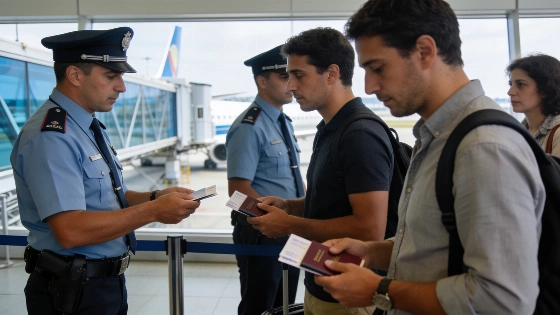
According to EFE, Italian State Police officers are now stopping both EU and non-EU passengers arriving from Spain, requesting identity documents or passports immediately upon disembarkation. Some travelers reported being asked for their documents multiple times, including at the jet bridge connecting the aircraft to the terminal. Additional selective checks are also taking place in public areas after baggage claim, occasionally causing brief congestion as passengers exit the arrivals area. While some travelers expressed frustration over the delays, others indicated support for the increased security measures.
The Italian government, led by Prime Minister Giorgia Meloni, justified the move as a measure to protect national security following the unprecedented influx of migrants into Ceuta, a Spanish enclave in North Africa. The controls specifically target third-country nationals arriving from Spain, aiming to ensure all travelers possess valid documentation for movement within the Schengen zone. Italian media report that only passengers with irregularities or suspicious circumstances will face further scrutiny. The suspension of Schengen rules is expected to remain in place throughout August, coinciding with the peak of the summer tourist season. Meloni has emphasized that authorities will seek to minimize disruption to tourism flows during this period.
In a statement on social media, Meloni reiterated the need for a coordinated European response to irregular migration, referencing the Ceuta crisis as a catalyst for urgent action. Together with Denmark's Prime Minister Mette Frederiksen, Meloni has rallied support from 22 other EU countries, calling for an extraordinary meeting of interior ministers to strengthen the bloc's external borders. She stressed that defending the EU's external frontiers is a shared European responsibility, not just a national concern.
The situation in Ceuta has stabilized after last week's dramatic events, when more than 60,000 migrants crossed into the enclave in a matter of days, resulting in at least 67 fatalities. As reported in recent coverage of the ongoing aftermath in Ceuta, local authorities and residents continue to grapple with the consequences of the mass arrival and the challenges of restoring order.
For context, the Schengen Agreement allows for passport-free travel across much of Europe, but member states can temporarily reintroduce border controls in cases of serious threat to public order or security. Italy's decision to suspend these rules for arrivals from Spain is a rare step, reflecting the scale of the current migration challenge. The move comes at a sensitive time for both countries, as August is traditionally the busiest month for tourism and cross-border travel. The effectiveness and duration of these controls will likely depend on developments in Ceuta and broader EU discussions on migration policy in the coming weeks.