Iván Kapustin, top scorer in Girona’s 2025 PAU, doubts he did enough to earn his 9.8. Now at UAB, he faces new challenges in adapting to university and pursuing his passion for music.
Iván Kapustin, a 19-year-old from Palafrugell, Girona, became the focus of media attention after scoring a 9.8 in the 2025 Selectividad (PAU), the highest mark in Girona and the fourth in Catalonia. Despite this achievement, Kapustin admits he was surprised by his own results, believing he had not studied as intensely as others in the final days before the exams. He describes leaving the exam rooms without the sense that he had excelled, and attributes his success more to consistent effort throughout the year than to last-minute preparation.
Kapustin’s background is marked by a blend of high expectations and personal modesty. His family’s story traces back to the Barcelona Olympics, when his uncle, an elite athlete, settled in Catalonia and brought his father, leading to his parents’ meeting. From an early age, Kapustin was identified as having high intellectual abilities, but he recalls that this did not significantly alter his school experience, aside from occasional advanced materials provided by some teachers.
Before receiving his PAU results, Kapustin was already recognized for his academic work, winning the University of Girona’s award for best scientific research with his project “Insectos. ¿La dieta del futuro?”. The project explored the economic and environmental feasibility of replacing traditional livestock with insect farming. This research led him to reflect on the ethics of animal consumption and sparked his interest in veganism, though health issues currently prevent him from fully adopting the diet.
After completing his first year of Biochemistry at the Autonomous University of Barcelona (UAB), Kapustin describes his academic transition as easier than expected, but socially challenging. He notes a lack of engagement among some students and expresses disappointment at not finding more like-minded peers. His interest in biochemistry was sparked in his final year of secondary school, particularly by research into the origins of life, which influenced his choice of university studies.
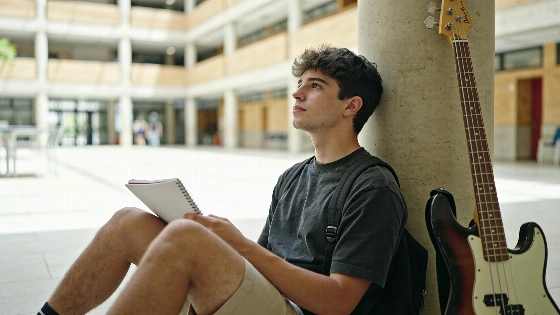
Kapustin’s interests extend beyond science. He has a deep passion for music, especially the electric bass. Having started with piano at age five, he later discovered the bass and now dedicates significant time to mastering the instrument. He admires virtuosos like Victor Wooten and Charles Berthoud, and is currently developing his own repertoire, including covers and original compositions. His ambition is to perform live, though he finds it difficult to assemble a band that shares his musical style.
While Kapustin’s academic journey is unique, his experience reflects broader trends among high-achieving students in Spain, where the pressure to excel in university entrance exams remains intense. The PAU, or Pruebas de Acceso a la Universidad, continues to be a decisive factor for university admission, shaping the academic and personal paths of thousands each year. As seen in other fields, such as sports, where young talents like Francisco Comesaña have made headlines for their achievements—recently advancing in the ATP 250 in Winston Salem, as reported in coverage of Spanish athletes abroad—the intersection of talent, opportunity, and personal drive remains a defining feature of youth success stories in Spain.
Kapustin’s story also highlights the challenges of transitioning from secondary education to university, especially for students with high expectations and diverse interests. The Spanish education system continues to evolve, with ongoing debates about the role of standardized testing, support for gifted students, and the integration of extracurricular passions such as music. For many, the journey is not only about academic results but also about finding a sense of belonging and purpose beyond the classroom.