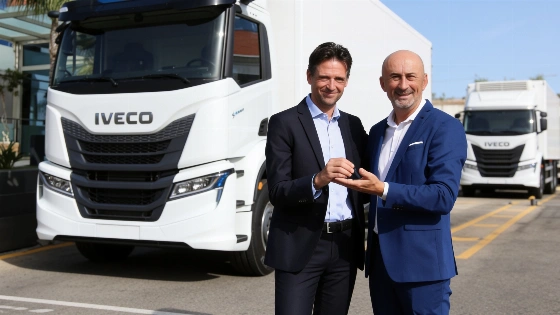
Disfrimur has become the first Spanish logistics company to operate the Iveco S-eWay Rígido, a fully electric heavy-duty truck. The vehicle will handle daily distribution routes between Murcia and Alicante, marking a milestone for zero-emission transport in Spain.
Disfrimur, a logistics company based in Murcia, has put Spain’s first fully electric heavy-duty Iveco truck into daily operation. The new S-eWay Rígido model is now running distribution routes between Murcia and Alicante, covering a distance of less than 100 kilometers per trip. This deployment signals a concrete step forward in the electrification of Spain’s commercial transport sector, where diesel has long dominated regional logistics.
The S-eWay Rígido stands out not only as the first of its kind from Iveco to enter service in Spain, but also as a vehicle designed from the ground up for electric propulsion. Unlike many electric trucks adapted from combustion-engine platforms, this model features a chassis, battery placement, and drivetrain engineered specifically for electric use. The result is a truck that maximizes efficiency and can be tailored for a range of professional applications.
Performance and Range
Equipped with two electric motors delivering a combined 840 kW (1,142 hp) and 45,000 Nm of torque, the S-eWay Rígido offers robust performance for regional distribution. Its modular lithium-ion NMC battery system can be configured with four, five, or seven packs, depending on operational needs. In its highest-capacity version, the truck achieves a certified range of up to 400 kilometers—enough to complete several daily routes without recharging during working hours.
Charging is designed to fit seamlessly into logistics schedules. The S-eWay Rígido supports rapid DC charging at up to 350 kW, allowing the battery to go from 20% to 80% in about 45 minutes. This window aligns with mandatory rest breaks for professional drivers, minimizing operational downtime. Additionally, the regenerative braking system can recover up to 150 kW during deceleration, further extending range and improving energy efficiency, especially on routes with frequent stops and starts.
Adaptability for Logistics
Iveco has prioritized versatility in the S-eWay Rígido’s design. The truck’s architecture allows for flexible battery placement, making it possible to install a variety of body types—such as refrigerated units, hydraulic lifts, cranes, or standard cargo platforms—without compromising performance. This adaptability is crucial for logistics companies seeking to electrify diverse segments of their fleets.
Disfrimur’s decision to integrate the S-eWay Rígido reflects a broader industry trend. As battery technology and charging infrastructure improve, more Spanish logistics operators are piloting electric trucks for regional and urban distribution. According to the company, this move is part of a long-term strategy to combine operational efficiency with environmental responsibility, aiming to reduce the carbon footprint of its services while maintaining competitiveness.
Context and Outlook
The arrival of the S-eWay Rígido is a milestone for both Iveco and the Spanish transport sector. The manufacturer describes this delivery as a key step in its plan to accelerate the decarbonization of professional logistics through practical, electric solutions tailored to real-world needs. The focus remains on planned, repeatable routes where electric trucks can operate reliably within their range limits.
Spain’s push toward electrified transport is not limited to trucks. The country has seen rapid adoption of electric cars and vans, and charging technology is evolving quickly. For example, leading brands are now rolling out seamless charging solutions, as highlighted in the recent overview of automatic Plug & Charge systems at Tesla Superchargers, which are making EV use more practical for both private and commercial users.
While heavy-duty electric trucks still face challenges—such as range limitations and the need for robust charging infrastructure—the deployment of the S-eWay Rígido on real routes demonstrates that zero-emission logistics is becoming a reality in Spain. As more companies follow Disfrimur’s lead, the landscape of Spanish road transport is set to change, with electric vehicles playing an increasingly central role in regional distribution.