Javier Calderón, former leader of Spain’s intelligence services, has died in Madrid at 95. He played a central role during the 1981 coup attempt and the country’s transition. His legacy remains closely tied to Spain’s most guarded secrets.
Javier Calderón Fernández, one of the most influential figures in Spain’s intelligence community, died in Madrid at the age of 95. His passing marks the end of an era for the country’s secret services, as Calderón was directly involved in some of the most sensitive episodes of Spain’s recent history, including the 1981 attempted coup and the transition from dictatorship to democracy.
Calderón’s career placed him at the heart of Spain’s intelligence apparatus. He first served as secretary general and de facto strongman of the Centro Español de Información para la Defensa (Cesid) during the turbulent period of the 23 February 1981 coup attempt. Later, between 1996 and 2001, he led the institution—by then the CNI—under the first government of José María Aznar. His close relationship with Manuel Gutiérrez Mellado, vice president under Adolfo Suárez, further cemented his influence during the country’s political transformation.
Born in Dos Barrios, Toledo, in 1931, Calderón’s early life was shaped by the violence of the Spanish Civil War. His father, a rural landowner, was executed by Republican forces in 1936. After moving to Madrid with his widowed mother, Calderón pursued a military career, entering the General Military Academy and later specializing in infantry and intelligence. He was part of a pioneering group trained in special operations and counterinsurgency, including courses led by US Green Berets, reflecting the close ties between Spanish and American military intelligence during the Cold War.
Throughout the Franco era and the transition, Calderón’s roles spanned several intelligence bodies, from the Organización Contrasubversiva Nacional to the SECED and finally Cesid. He rose through the ranks, gaining expertise in counter-subversion and intelligence, and was involved in the creation of key military and intelligence networks. His connections extended to influential groups such as Forja, a Christian military association, and to figures later implicated in the 1981 coup attempt.
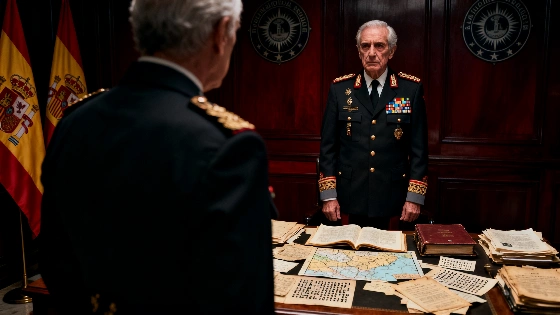
During the 1981 coup, Calderón was secretary general of Cesid, formally under the command of Colonel Narciso Carreras but effectively in charge. The attempted seizure of the Congress by Antonio Tejero and the involvement of high-ranking military officers placed the intelligence services under intense scrutiny. Allegations surfaced about Cesid agents’ roles in supporting the coup, but only José Luis Cortina, a close associate of Calderón, faced trial and was ultimately acquitted. The full extent of Cesid’s involvement remains unclear, as many documents from that period are still classified under Spain’s Official Secrets Law, which lacks clear declassification deadlines.
When Calderón became director of Cesid in 1996, he initiated a sweeping review of the agency’s personnel, resulting in the dismissal of dozens of agents, including those who had previously reported on Cesid’s alleged involvement in the 1981 events. Sources from the AOME, a special operations group within Cesid, claim Calderón was instructed to dispose of sensitive documents related to the coup, further deepening the mystery surrounding those years.
Calderón’s personal life was marked by discretion. He was the father of two sons and a daughter, Beatriz, who also served in intelligence roles abroad. Known for his polite demeanor and reserved nature, he rarely discussed his professional activities, even among friends and neighbors in his Madrid residence and his home near Hoyo de Manzanares.
Spain’s intelligence services have undergone significant changes since Calderón’s era, but the legacy of secrecy and the unresolved questions from the transition period continue to shape public debate. The Official Secrets Law, enacted in 1968 and still in force with only minor modifications, has been criticized for its lack of transparency and for shielding key historical episodes from public scrutiny. Calderón’s death closes a chapter on a generation of intelligence officers whose actions remain partly hidden from history.