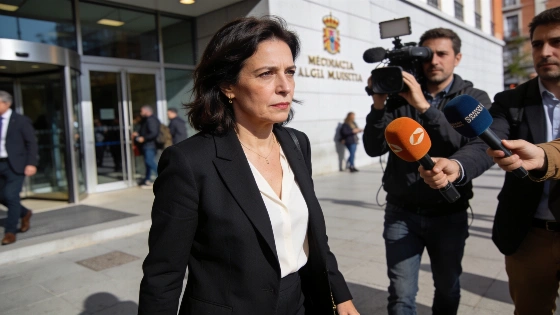
A Madrid court has summoned Begoña Gómez, wife of Spain’s prime minister, to testify over accusations of filing a false assault report. The case stems from a confrontation with activist Vito Quiles in a Las Rozas restaurant. Both parties are due in court.
Begoña Gómez, wife of Prime Minister Pedro Sánchez, has been ordered by a Madrid judge to appear in court over accusations that she filed a false police report. The case began after Vito Zoppellari Quiles, a far-right activist, accused Gómez of wrongly reporting him for assault during an argument in a Las Rozas restaurant in April.
If found guilty of making a false accusation, Gómez could face six months to two years in prison, depending on the court's decision. Both Gómez and Quiles have been summoned to testify on October 23 in Majadahonda, where they will appear as defendant and complainant. The case has drawn national attention and added to ongoing political tensions.
The original complaint by Gómez was dismissed on May 30, 2026, after the judge found that video evidence did not support her claims of aggression or blocked exit.
The dispute centers on an incident from April 19. Gómez, who was with a man and two friends, was approached by Quiles inside the restaurant. According to sources from La Moncloa, Quiles confronted Gómez, blocked her exit, and filmed her while pressing her about her public role. Gómez’s complaint described Quiles as invading her personal space and preventing her from leaving. However, after reviewing video footage, the court found no evidence of aggression or that Gómez was blocked from leaving. The judge concluded that Gómez was able to exit the restaurant without interference.
Judge Sergio Burguillo reviewed the video evidence in late May and found no proof of physical aggression or that Quiles blocked Gómez’s path. While Quiles did approach and question her, the footage showed Gómez leaving the restaurant immediately, with no physical contact. The judge dismissed Gómez’s complaint, stating the evidence did not support criminal charges against Quiles. This allowed Quiles to file a counter-complaint, accusing Gómez of knowingly making a false report. Under Spanish law, such a charge can only proceed after the original case is closed.
With the initial case dismissed, Quiles quickly filed his own complaint. Both Gómez and the public prosecutor have appealed the dismissal, and the Provincial Court is set to review the matter next week. According to Libertad Digital, the court has requested Gómez’s prior criminal record and the full file from the previous proceedings, a step that usually means the judge is considering whether there is enough evidence to move forward with the false report case.
In parallel to this case, Spanish prosecutors have recently requested the acquittal of Gómez and her associates in a separate high-profile investigation concerning her role at the Universidad Complutense, stating that no criminal conduct was found.
Quiles has been involved in several legal disputes in recent months. He is under investigation for alleged misuse of charitable donations, faces a fraud complaint from Renfe for abusing train ticketing rules, and is involved in ongoing cases for defamation and hate speech brought by consumer rights advocate Rubén Sánchez. Earlier this summer, a judge ordered Quiles’s detention for spreading false information about a public employee. RTVE and El Plural have reported that Quiles’s confrontational style has led to further sanctions and debate about his conduct in public spaces, adding to the political sensitivity of the current proceedings.
The legal dispute between Gómez and Quiles comes as Spain’s courts face scrutiny over their handling of high-profile political cases. The rapid escalation from a restaurant argument to a criminal summons for the prime minister’s wife highlights the pressures of public life at the top. Meanwhile, other recent developments, such as changes in mortgage conditions affecting thousands of households, reflect a broader climate of legal and financial uncertainty in Spain.
This case shows how legal battles in Spain are increasingly fought in public, with reputations and political futures at stake. Both sides appear determined to pursue every legal option, regardless of the personal or political cost. With the prime minister’s family now directly involved, the stakes are even higher, exposing the fragility of public trust in both the legal system and those in power.