A new survey shows most Spaniards suspect political interference in the courts. Judges are divided, with conservatives denying lawfare and progressives citing controversial rulings. The debate exposes tensions over judicial independence.
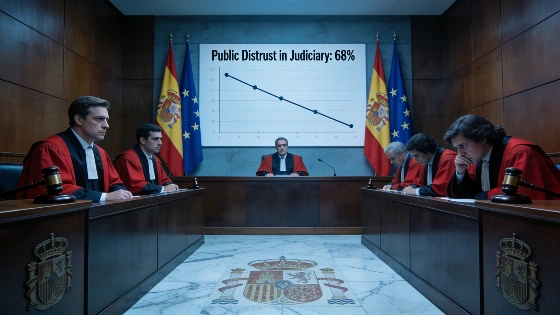
Concerns over the independence of Spain’s judiciary have intensified after a recent survey found that more than 65% of respondents believe lawfare—politically motivated legal actions—exists in the country. The study, conducted by Instituto 40dB for EL PAÍS and Cadena SER, has sparked a sharp debate among judges and legal associations, highlighting a deep divide over the role of politics in the justice system.
Conservative judges firmly reject the idea that lawfare is present in Spain, insisting that judicial decisions are made independently and strictly according to the law. María Rubio, from the Asociación Judicial Francisco de Vitoria (AJFV), emphasized that judges are impartial and not influenced by political events. She argued that the judiciary acts solely on legal grounds, regardless of whether the accused is a politician or not. However, Rubio acknowledged that recent years have seen efforts to undermine the judiciary’s image, leading to growing public distrust.
Progressive voices within the judiciary, however, admit that some court decisions are difficult to understand and may contribute to the perception of lawfare. Edmundo Rodríguez, spokesperson for Juezas y Jueces para la Democracia (JJpD), pointed to controversial rulings, such as the conviction of former Attorney General Álvaro García Ortiz for revealing sensitive negotiations involving a high-profile political figure. Rodríguez argued that the widespread sense of lawfare is fueled by both political instrumentalization of the courts and a lack of rigor in certain judicial actions.
The debate extends to the Consejo General del Poder Judicial (CGPJ), Spain’s judicial governing body, which remains split along ideological lines. The survey revealed that the CGPJ is one of the least trusted institutions, with a rating of 4.6 out of 10, and 58% of respondents believe it does little to oversee or discipline judges who perform poorly. Progressive members of the CGPJ agree with this assessment, citing delays in handling high-profile disciplinary cases, such as those involving Judge Juan Carlos Peinado and his investigation into Begoña Gómez, the wife of the Prime Minister. Some cases have been closed, but several remain unresolved, including complaints from government ministers.
Conservative members of the CGPJ, on the other hand, categorically deny the existence of politically motivated prosecutions. They attribute the negative public perception to political attacks on the judiciary, warning that such criticism undermines confidence in the justice system. Conservatives also argue that the CGPJ is hampered by a lack of budgetary autonomy, which limits its ability to act decisively, and point to recent government refusals to fund judicial reinforcements as an example of these constraints.
On disciplinary matters, conservative sources maintain that each case is thoroughly reviewed and sanctions are imposed when necessary, regardless of external pressures. They stress that the CGPJ remains open to criticism but insist that technical criteria, not politics, guide their decisions.
The issue of lawfare and judicial independence has become a flashpoint in Spain’s ongoing political debate. The CGPJ itself has faced criticism for operating with an expired mandate for several years due to political deadlock, further fueling doubts about its effectiveness and impartiality. The controversy reflects broader concerns about the separation of powers and the resilience of Spain’s democratic institutions.
Spain’s judiciary is structured to ensure independence, with judges appointed through competitive exams and protected from arbitrary dismissal. However, the appointment of senior judicial figures, including members of the CGPJ and the Constitutional Court, often involves political negotiation, which can create perceptions of bias. The lawfare debate has gained prominence in recent years, especially in cases involving high-profile politicians and public officials. While the judiciary remains one of the most respected branches of government according to some surveys, persistent doubts about political interference continue to challenge public trust. The ongoing discussion underscores the importance of transparency, accountability, and clear boundaries between the judiciary and political actors in maintaining confidence in Spain’s legal system.