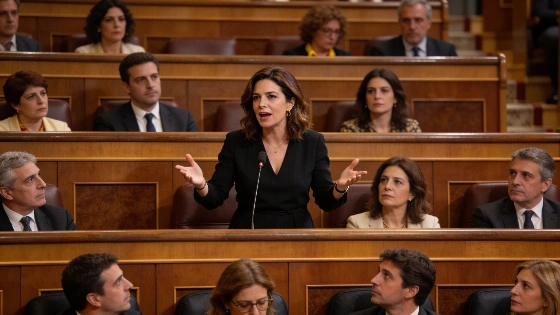
Junts has warned the government it will block any measure if Catalonia is included in the latest distribution of unaccompanied migrant minors from Ceuta. The party insists on Catalonia’s exemption, citing previous agreements and regional strain.
Political tensions have escalated in Madrid after Junts, through its spokesperson Míriam Nogueras, issued a direct warning to the government: the party will not back any initiative if Catalonia is included in the upcoming allocation of unaccompanied migrant minors who recently arrived in Ceuta. Nogueras made clear that Junts expects Catalonia to be left out of the distribution among Spain’s autonomous communities, referencing the party’s previous success in securing an exemption for the region during a similar process involving minors from the Canary Islands last year.
In her statement, Nogueras criticized what she described as ongoing pressure on Catalonia to absorb more migrants without adequate resources. She argued that, historically, Catalonia has already taken in a disproportionate number of minors compared to other regions, and accused other Catalan deputies of failing to defend the region’s interests in previous negotiations. According to Nogueras, Junts acted alone to prevent what she called continued abuse by the central government.
The dispute comes after a failed attempt in July 2024 to reform Spain’s immigration law, which would have made the reception of migrant minors mandatory for all regions. Junts joined forces with PP and Vox to block the proposal, which had been negotiated by PSOE and Sumar with Coalición Canaria. At the time, the Generalitat, then under Esquerra Republicana in a caretaker capacity, called for recognition of Catalonia’s unique situation, citing its higher intake of migrants in recent years.
After months of negotiations, Junts and the government reached a deal in March 2025 to amend Article 35 of the immigration law via a Royal Decree-law. Under the new criteria, the distribution of minors is based on factors such as population, per capita income, unemployment rate, and the structural capacity of each region. As a result, only about thirty minors from the more than 4,000 in centers in the Canary Islands and Ceuta were assigned to Catalonia, while Madrid was set to receive over 700. The agreement also considered whether a region is a border area, island territory, or has a dispersed population.
This latest standoff highlights the ongoing debate over regional responsibilities in Spain’s migration policy. The issue of unaccompanied minors arriving in Ceuta has repeatedly tested the relationship between the central government and autonomous communities. As noted in a recent analysis, European support for Spain’s handling of the Ceuta crisis has shifted, with EU ministers now focusing on broader migration challenges rather than criticizing Madrid’s approach (see how EU ministers have changed their stance on Spain’s Ceuta response).
Spain’s system for distributing unaccompanied migrant minors is designed to balance the burden among regions, but political disagreements often complicate implementation. The debate over Catalonia’s role reflects broader tensions about autonomy, resource allocation, and the limits of regional solidarity. The outcome of this dispute could set a precedent for future migration policy decisions, especially as arrivals to Spain’s southern borders continue to fluctuate.