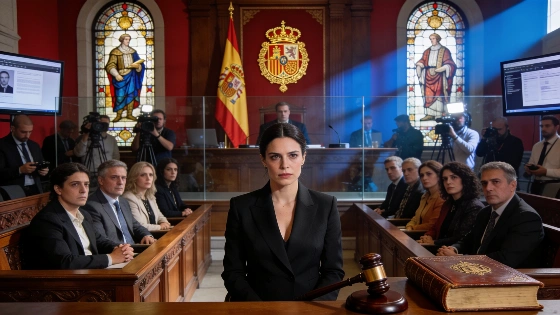
A Madrid court has confirmed that Begoña Gómez, wife of Spain’s prime minister, will be tried by a jury. The decision revives a decades-old debate over the role and limits of citizen juries in complex cases.
The Audiencia Provincial de Madrid has ruled that Begoña Gómez, spouse of the Spanish prime minister, will face trial by a jury of nine citizens and two alternates. This decision, following months of legal back-and-forth, places Gómez in the spotlight over charges of embezzlement and influence peddling—two of the four original accusations. The move to a jury trial has reignited longstanding controversy about the suitability of citizen juries for high-profile and technically complex cases, especially those that attract intense media attention.
The debate over Spain’s jury system is not new. Since the introduction of the Ley Orgánica 5/1995 del Tribunal del Jurado, the legal community has remained divided. Supporters argue that the jury is a democratic institution essential to modern justice, while critics see it as outdated and ill-suited to cases involving intricate legal or financial matters. The Spanish model, a hybrid between the Anglo-Saxon and German systems, allows juries to determine facts and issue verdicts, but sentencing remains the judge’s responsibility.
Concerns about the jury’s competence in cases involving technical crimes, such as embezzlement or influence peddling, have persisted since the law’s inception. Traditionally, juries were reserved for so-called “natural” crimes like homicide, where the facts are more accessible to laypeople. However, the current list of jury-eligible offenses includes a range of crimes, some of which require specialized legal understanding. Critics argue that this expansion complicates the pursuit of fair and informed verdicts.
Another persistent issue is the selection of jurors. With widespread media coverage and public debate, finding impartial candidates has become increasingly difficult. The law allows both sides to dismiss a limited number of potential jurors without cause, but the process remains less refined than in countries with a longer tradition of jury trials. The case of Dolores Vázquez, convicted by a jury in the high-profile Wanninkhof murder before being exonerated, is often cited as a cautionary example of the risks posed by media influence and insufficient jury training.
Despite these challenges, some legal experts maintain that most jurors take their responsibilities seriously once sworn in. The oath, which emphasizes impartiality and confidentiality, is intended to reinforce the gravity of the role. However, the original version of the oath, which included a clause about accountability to fellow citizens, was quickly removed from the law.
Statistical data from the Consejo General del Poder Judicial (CGPJ) shows that jury trials remain rare in Spain, accounting for just 0.075% of verdicts in 2024. Notably, 89.7% of jury verdicts are convictions, a figure largely attributed to homicide cases. Calls for reform persist, with some advocating for a broader or narrower scope of jury-eligible crimes, and others suggesting the law should be overhauled entirely.
For context, Spain’s jury system was reintroduced in 1995 after being suspended during the Franco era. Unlike in the United States, Spanish defendants cannot opt out of a jury trial in favor of a professional judge. The ongoing debate reflects broader questions about the balance between democratic participation and legal expertise in the justice system. As the Gómez case proceeds, the effectiveness and future of the jury system in Spain will remain under scrutiny.