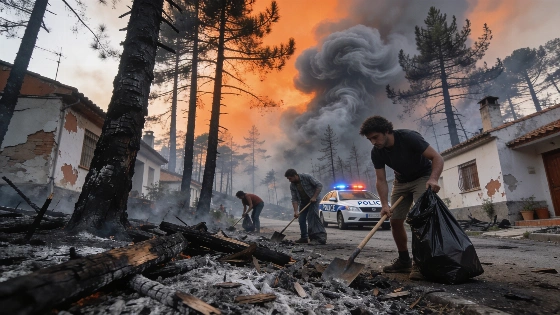
A devastating wildfire in La Atalaya, El Tiemblo, has left homes damaged and residents vulnerable. As locals return to assess the destruction, reports of looting add to the crisis. Authorities and neighbors struggle to restore order.
In La Atalaya, a residential area in El Tiemblo (Ávila), the aftermath of a major wildfire has left residents not only clearing away ash and debris but also confronting a wave of thefts. The fire, which swept down from the surrounding pine forest, caught many by surprise despite long-standing concerns about neglected woodland and increasingly severe summers. Now, as the smoke lingers, the community faces the dual challenge of recovering from the blaze and protecting their properties from opportunistic criminals.
Many homeowners, including Iván George and Iván Costica, returned from Madrid as soon as roadblocks allowed, only to find their houses covered in soot and their neighborhoods eerily quiet. Security cameras captured the fire’s rapid advance, and for some, the devastation was compounded by the realization that thieves had entered while residents were evacuated. The sense of vulnerability is heightened by the knowledge that many homes were left unlocked to aid emergency crews, inadvertently making them easy targets.
Visible scars remain throughout La Atalaya. Charred pine trees, scorched gardens, and melted pool tiles are common sights. Some residents, like Luisa Hernández and Javier Torres, consider themselves fortunate that their homes survived, even as they discard spoiled food and survey the damage to their property. They credit the survival of their house to both luck and the efforts of neighbors like Julio César Blázquez, who worked tirelessly with makeshift tools to contain the flames. Blázquez, a local resident, described the fire’s speed and intensity as beyond anything he had imagined, recalling how he and others spent the night in a nearby sports hall before returning to defend what they could.
Elsewhere, the fire’s path was influenced by the state of adjacent plots. Miguel Ángel and Yolanda Torrado noted that their home was spared in part because they had previously insisted a neighbor clear overgrown trees and brush. In contrast, abandoned lots with dense vegetation acted as fuel, accelerating the fire’s spread and increasing the risk to nearby houses. The destruction is evident in melted rubbish bins, damaged hoses, and even gas canisters thrown into pools as a precaution.
As residents attempt to restore some normalcy, the presence of the Guardia Civil has become more visible. Patrols respond to reports of suspicious activity, with some locals mistaking journalists for potential thieves. Authorities confirm that several complaints have been filed, as criminals exploit the chaos and absence of homeowners to steal what the fire did not destroy. The frustration among residents is palpable, with many expressing anger at those taking advantage of the disaster.
The situation in La Atalaya reflects a broader pattern seen in other parts of central Spain affected by wildfires. Similar incidents of property loss and looting have been reported in Ávila and Madrid, as detailed in recent coverage of wildfire impacts across the region. The combination of environmental risk and criminal activity underscores the challenges facing communities in the wake of such disasters.
Wildfires are a recurring threat in Spain, particularly during the hotter months when dry conditions and unmanaged forests increase the risk. Authorities often urge property owners to maintain clear perimeters and support fire prevention efforts, but enforcement and resources can be inconsistent. The events in La Atalaya highlight the importance of both community vigilance and coordinated response, as residents balance immediate recovery with longer-term concerns about safety and prevention. As the area begins to rebuild, the experience serves as a stark reminder of the vulnerabilities exposed by natural disasters and the need for ongoing attention to both environmental management and security.