La bola negra reaches Spanish cinemas on 25 September. Los Javis connect Lorca with queer identity and a family's buried memory across three timelines.
A lost manuscript sits at the heart of La bola negra. It gives the film its strongest dramatic pull. Directed by Javier Ambrossi and Javier Calvo, the story links Federico García Lorca to queer identity, historical violence and a family secret that survives into modern Madrid. The film reaches cinemas on 25 September after a strong festival run.
The film has already won the award for best direction at Cannes, sharing the prize with another winner. It also took the audience prize in Toronto. That result has put it on what some have called an almost direct route to the Oscars. At the Festival de San Sebastián, it received the second-highest audience rating in the event's history. The production now faces a long campaign that could take it to Hollywood for the film industry's major ceremony on 14 March. The Hollywood Reporter and CBC reported the Toronto People's Choice Award. El País called the film one of Spain's leading awards-season contenders.
After its Cannes premiere, Netflix acquired the film’s U.S. rights, making the platform part of La bola negra’s international release and awards campaign.
The starting point is literary, but also speculative. La bola negra draws on Alberto Conejero's play La piedra oscura, which he co-wrote with Los Javis, and on four surviving pages from an unfinished work by Lorca. That fragment was the first piece by the Granada-born poet to feature a homosexual protagonist. The film asks what might have happened if the manuscript had been completed and published in the present. It also asks who might have kept it hidden.
Three periods carry that question.
In Granada in 1932, the young La bola negra, played by Milo Quifes, tries to enter the city's Casino. His fate rests on a committee vote. A black ball means no. A white ball means yes. In 1937, a wounded Republican soldier, played by Miguel Bernardeau, is captured by the Nationalist side. A man played by Guitarricadelafuente cares for him. The prisoner is Rafael Rodríguez Rapún, the only real historical character in the film. He was a member of La Barraca and Lorca's partner. The 2017 strand follows Carlos González through Madrid as he investigates the identity of a grandfather he never knew and the extraordinary inheritance left to him.
Los Javis have described the film as a tribute to the LGBTQ+ community of the past and as an epic gay drama for everyone. The framing places Lorca’s unfinished text within a broader story about identities and lives pushed out of the official record.
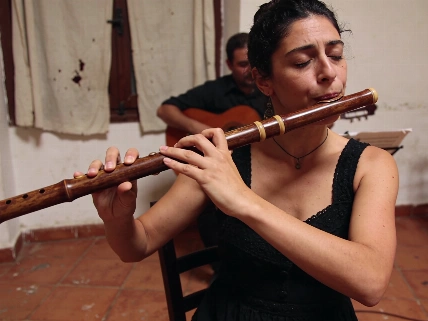
The women around these men are not decorative figures. Penélope Cruz plays Nené Romero, a cabaret performer entertaining troops during the war. Lola Dueñas plays Carlos González's angry mother. Glenn Close portrays a renowned Hispanist with deep knowledge of Lorca. Yenesi plays a friend of the unknown grandfather. Their roles tie private grief to public history.
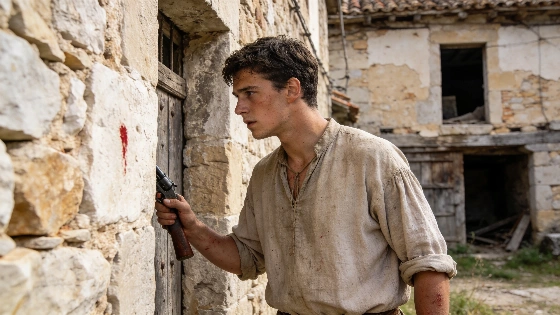
The locations carry that same sense of place. The opening wartime sequence was filmed in Castil de Carrias, an abandoned village in Burgos. The production chose it because its ruined buildings could be adapted and then destroyed during the bombing scene. The northern storyline took the crew to Comillas, where the old university became an improvised prison and hospital. The building had once served as a real blood hospital. It had to be cleared extensively before filming.
Other locations keep that focus on physical truth. The beaches of La Arnía and Oyambre host the soldiers' cold bathing and singing scenes. A decaying theatre in Sigüenza became the setting for Cruz's cabaret performances. In Granada, exterior scenes were shot around Plaza de Santa Ana. The Casino and Café Imperial were built through a mix of Madrid exteriors and constructed interiors.
For the contemporary story, the production used La copita asturiana for the confrontation between Carlos and his mother over fabada. The Ateneo became the meeting place with Close's Hispanist. Lafuente in Cantabria supplied the grandfather's village. Even a house outside Madrid had to be found in genuine renovation. The choice preserved the production's preference for discovered reality over artificial reconstruction. That attention to place gives the film's memory theme a physical dimension, much as an earlier report shows how locations can carry consequences beyond the frame.
La bola negra goes beyond a Lorca homage. It turns an incomplete text into a story about the cost of concealment and the value of recovering what families and societies have refused to name. Its strongest feature is the way it joins musical grandeur to intimate lives. Love, art and desire become forms of resistance against fear and hatred. The festival results and carefully grounded settings make memory more than a backdrop. Memory becomes the film's central action. According to Netflix Tudum and trade-press reports, the Spanish theatrical release on 25 September will be followed by a U.S. release in October and streaming in December. The conversation will continue beyond the festival circuit.