Andalusia’s beaches face closures after sewage contamination. Ageing treatment plants cannot handle the summer influx. Millions in water infrastructure funds remain unused as health and tourism risks mount.
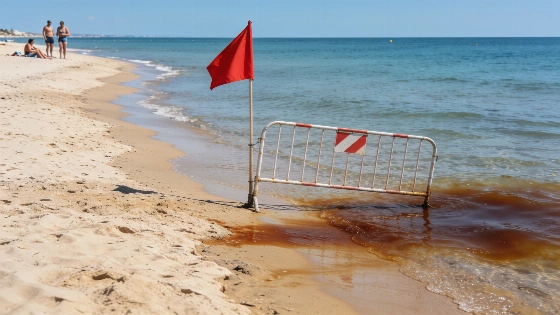
Brown water at the shoreline and sudden swimming bans have become common on many of Andalusia’s busiest beaches. This summer, authorities in four of the region’s five coastal provinces closed parts of the coast after finding unsafe levels of fecal bacteria—directly linked to old sewage systems failing under record tourist numbers.
In Huelva, Cádiz, Málaga, and Granada, water treatment plants built for much smaller populations are now overwhelmed. Some towns see their numbers swell tenfold during peak months. The Junta de Andalucía expects 14.2 million visitors between July and September. The result: infrastructure from 25 years ago is breaking down, and the evidence is visible in the water. “The water was brown,” says Rocío García, a regular at Doñana beach, who shared photos of the shoreline stained like a clogged drain.
In September 2026, Benalmádena once again closed Bil Bil beach after water tests revealed excessive E. coli levels, with the ban remaining until new safe results are confirmed.
Much of the problem comes down to neglect and mismanagement. More than €650 million collected to upgrade sewage networks has not been spent or was used for other projects, according to the Cámara de Cuentas. Meanwhile, tourism—worth €26.9 billion and supporting half a million jobs—is now at risk, with local authorities unable to contain the threat to health and reputation. Reports from Spanish media and the Junta de Andalucía confirm that closures are a preventive measure based on water tests, and bans are only lifted after new results show it is safe.
Experts blame two main factors: the summer population surge and the age of treatment plants. Joan Corominas, former director of the Agencia Andaluza del Agua, says many plants are well past their intended lifespan and have had little maintenance. “Operators cut costs and do the bare minimum, so the system is now bursting at the seams,” he says. The problem is mostly hidden until it reaches the beaches, but the impact is immediate for locals and tourists. In August and September 2026, several beaches in Málaga and Cádiz—including Bil Bil, Arroyo de la Miel, Los Melilleros, Santa Ana, and Las Gaviotas—were closed after routine tests found high levels of E. coli and enterococci, the two main signs of fecal contamination in seawater.
Antonio Figueroa, a geographer and founder of Estudio Agua y Territorio, points to another issue: thousands of homes are still not connected to municipal sewage and use septic tanks, which may not be properly maintained. He notes that even where new treatment plants were planned over a decade ago, construction has not started. Figueroa says the water levy must be fully invested and municipalities must take more responsibility, especially by limiting new developments without proper sewage systems.
After heavy rains on August 15, 2026, water quality on Málaga's western coast deteriorated further, prompting renewed beach closures. Similar incidents were reported in Cádiz, Chipiona, El Puerto de Santa María, Vilagarcía, and Baiona in early September, indicating a broader summer episode of water contamination beyond just one province.
RTVE
Figures from Ecologistas en Acción Andalucía show that nearly 29% of urban areas in the region do not meet wastewater treatment standards. Córdoba performs best, but Málaga lags behind, with less than half of its urban areas compliant—a sharp drop from 2017. Granada and Almería also fall short, with compliance rates of 57% and just over 61%.
The financial side is just as troubling. Of the €1.4 billion raised through the water levy, only 47.5% has gone to its intended use. The rest remains unused or spent elsewhere, even as Spain faces EU fines for non-compliance—almost €90 million so far, with Alhaurín el Grande alone costing €2.1 million a year in penalties. Luis Babiano of Aeopas, the public water operators’ association, points to a clear investment gap: Sevilla and Málaga were each promised 58 major projects, but Sevilla received €99 million while Málaga got just €40 million. He says this shortfall is a direct cause of the environmental crisis now unfolding on the Costa del Sol.
Aeopas has identified 25 treatment plants with the worst failures, half of them on the coast. The pattern is the same: seasonal overload, outdated equipment, and plants running years past their design limits. Babiano calls for urgent reforms to speed up contracting and land acquisition, noting that some projects have been stuck in bureaucracy for over 20 years. He also wants water levy funds to be used only for their original purpose, not diverted to storm repairs or other expenses.
With 108 municipalities now under EU scrutiny, Babiano is calling for a full audit—not just of the money, but of the delays and the real state of Andalusia’s water infrastructure. The Junta de Andalucía has not provided updated information on the status of treatment plants or future investment plans.
Environmental and infrastructure crises are not new to Spain’s Mediterranean coast. As reported earlier, Valencia’s Devesa del Saler faced its own disaster after a major wildfire, exposing similar gaps in prevention and response. The pattern is clear: when critical infrastructure is neglected, the consequences are swift and public.
Andalusia’s sewage failures are more than a technical problem—they threaten public health, the environment, and the region’s economy. The refusal to invest earmarked funds, slow action by local authorities, and lack of transparency from the Junta have created a crisis. Until these failures are addressed with real urgency and accountability, the region’s beaches will remain at risk, and the costs—financial, environmental, and reputational—will keep rising.