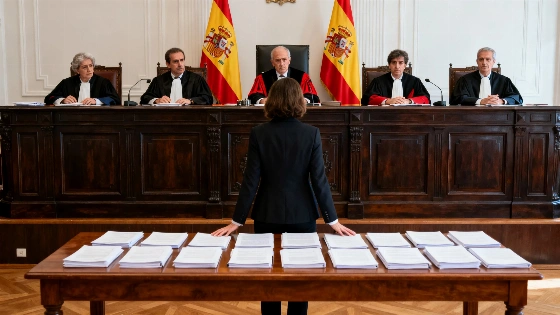
Madrid's Provincial Court is set to rule on whether Begoña Gómez, wife of Spain's Prime Minister, will face a jury trial over alleged corruption and influence peddling. The decision could reshape the legal process for all accused.
The Provincial Court of Madrid is preparing to rule on a pivotal legal question: should Begoña Gómez, spouse of the Prime Minister, be tried by a jury in a case involving allegations of corruption and influence peddling? The decision, expected after a full judicial panel review, could determine the course of one of Spain’s most closely watched legal proceedings in recent years.
Five magistrates, led by presiding judge Rosario Martínez Meilán and with Enrique Jesús Bergés as rapporteur, will meet in an expanded session to examine the ruling by Judge Juan Carlos Peinado. Peinado had ordered Gómez, her advisor Cristina Álvarez, and businessman Juan Carlos Barrabés to stand trial before a popular jury. The panel will also address appeals concerning the dismissal of professional misconduct charges and a dispute over the structure of the joint popular prosecution led by Hazte Oír.
Legal sources indicate that the court’s decision will not be immediate, as the judges must issue a detailed, reasoned order. Deliberations could extend beyond a single day, especially given the complexity and significance of the issues at stake. The case, initiated in April 2024, centers on Gómez’s role as co-director of a university chair at the Complutense University of Madrid, the development and sponsorship of related software, and whether she influenced public contracts in favor of Barrabés. The involvement of her publicly funded advisor is also under scrutiny.
The Provincial Court, which has previously both upheld and overturned Judge Peinado’s decisions, will now decide whether the charges—ranging from influence peddling and business corruption to embezzlement and misappropriation—should be heard by a jury. Notably, the court had earlier revoked Peinado’s attempt to investigate embezzlement in a separate proceeding and annulled his initial move to shift the case to a jury trial due to insufficient justification. In response, Peinado issued a new, more detailed order in April, reaffirming his stance on a jury trial and dismissing the professional misconduct charge against Gómez.
Following this, both the prosecution and defense appealed, arguing that the evidence was insufficient and that the case against Gómez was based on conjecture, with her legal team suggesting the proceedings were motivated by her status as the Prime Minister’s spouse. The defense for Álvarez maintains she merely performed her duties, while Barrabés insists there is no evidence linking him to the alleged crimes. The prosecution has consistently called for the case to be dropped, asserting that none of the accused committed any crime and challenging the need for a jury trial.
On June 20, Judge Peinado formally opened the oral trial phase, imposing precautionary measures on Gómez and Álvarez, including passport withdrawal, a travel ban, and mandatory court appearances. The Section 23 magistrates will also address further appeals, such as those contesting the indictments, at a later date.
This high-profile case has drawn national attention, not only for its political implications but also for the legal precedents it may set regarding jury trials in complex corruption cases. The outcome could influence future proceedings involving public figures and allegations of misuse of public resources. The situation echoes other recent judicial controversies in Spain, such as the legal battles surrounding Vicent Mompó, which also highlighted tensions between political office and judicial scrutiny—an issue explored in detail in a related report on calls for legal action against the president of Valencia’s provincial council.
Spain’s legal system allows for jury trials in certain criminal cases, but their use in high-profile political matters remains rare and often contested. The decision by Madrid’s Provincial Court will be closely watched for its impact on the balance between judicial independence and political accountability, as well as for its practical consequences for those involved.