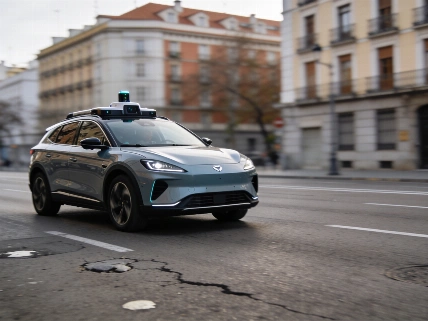
Madrid could see robotaxis operating commercially before the year is out as Spain and the European Commission work to clear a path for self-driving vehicles. They have been confined to small pilot programs for years. That could soon change.
The effort is being led by Jordi Hereu, Minister of Industry and Tourism, and José Antonio Santano, Secretary of State for Transport and Sustainable Mobility. Stéphane Séjourné, the European Commission’s Executive Vice-President for Prosperity and Industrial Strategy, is also involved. The three officials signed a joint declaration addressing a longstanding problem: every country in Europe sets its own rules for approving, testing and operating autonomous vehicles. The European Commission says the Joint Declaration of Intent is not binding law. It is a political commitment to cooperate on technical standards, certification and mutual recognition between countries.
After Spain joined, Portugal, Slovakia and Norway followed, bringing participation in the cross-border autonomous vehicle initiative to 22 countries, up from the original 18 EU signatories in June.
The plan aims to establish a single European structure. If a technology is certified and tested in one country, it could be used in others with little additional paperwork. That could help move autonomous vehicles from small trials into the wider European market. Still, sector analysts and the Spanish automotive association Anfac point out that each country will retain its own permits and technical checks.
Spain is helping shape the agenda rather than simply following Europe’s lead. The government is promoting the “Made in EU” idea and wants Spain to play a larger role in Europe’s industrial future. Its strong car industry and growing clean energy sector, along with a focus on new technology, put the country in a good position. The Spanish automotive industry supports Spain’s involvement. Industry sources say this could speed the shift from testing to real-world use of autonomous vehicles, with clearer rules and smoother operations.
Efforts to establish common rules for self-driving vehicles are not new. Spain has already joined European projects for cross-border driverless car testing, reflecting its commitment to rolling out these technologies safely and quickly. The European Commission says the plan goes beyond robotaxis, covering passenger transport as well as freight and logistics. It also includes commercial cross-border trips without a safety driver.
The European Commission links the initiative to the European Automotive Action Plan, which aims to replace fragmented local experiments with coordinated commercial deployment of autonomous transport. The plan brings national governments together with regional and municipal authorities, automakers and transport operators to develop a unified approach to Europe’s mobility future.
For Madrid, robotaxis will test whether European cooperation can deliver practical results for cities and residents. If the new rules work, the city could set an example for scaling new idea across borders, cutting red tape and opening up more opportunities for industry and consumers. But the declaration does not guarantee that robotaxis will reach Madrid’s streets right away. EU officials say it speeds up planning and the creation of test zones. Each country still needs to issue its own permits and establish routes and checks before commercial robotaxis can operate.