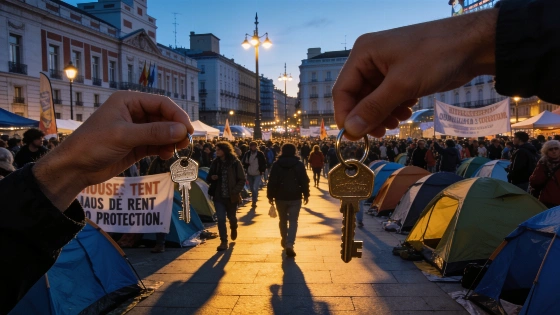
Thousands gathered around a new camp in Puerta del Sol after a mass housing march. Organisers are demanding urgent action from the Government on evictions, rents and tenant protection.
The protest began at 18:30 in an overcrowded Puerta del Sol. Moving through the square was difficult. Participants later headed slowly towards Cibeles and the Ayuntamiento de Madrid.
By 22:00, thousands of people had gathered around about thirty tents. Riot-control units that had been present moved away from the centre of the square. The camp was taking shape.
The Sindicato de Inquilinas said the tents were meant to "escalar la presión" on the Government. The union also said what happened to Maricarmen must not happen again.
Estimates of the march’s size differed sharply: the Delegación del Gobierno put attendance at 25,000, while organisers claimed 300,000 participants. RTVE and Associated Press described the turnout as tens of thousands.
Reports by RTVE, elDiario.es and Público said the route continued to the Congreso de los Diputados. Protesters carried keys. Organisers described them as the symbol of the current housing movement.
The crowd shouted "Expropiación a los fondos de inversión", "No habrá paz para el rentismo", "Los invasores son los fondos buitres" and "El que no salta es rentista".
The claimed turnout is central to the political message. The Sindicato de Inquilinas de Madrid said more than 300,000 people joined the march. The union called it alongside social groups, trade unions, neighbourhood organisations and other supporting bodies.
That number is disputed.
The march was presented as a historic moment in the housing struggle. Organisers linked it to 26 September, 13 October, 23 November, 5 April and 6 June.
At the former Palacio de Correos, Alicia del Río accused the Ayuntamiento de Madrid of helping investment funds. She referred to the 2013 sale of social and public homes to Blackstone. The union said the sale gave the fund "una alfombra roja".
The allegation places the current mobilisation inside a longer dispute over the transfer of public housing and the role of large property investors.
The mobilisation was framed not only around Maricarmen’s case but also around Spain’s wider housing crisis. Associated Press and RTVE reported that protesters were demanding stronger tenant protection and restrictions on speculation in the rental market.
The proposed "Decreto Maricarmen" brings together several of the movement's main demands. They include measures to prevent evictions of vulnerable households without alternative accommodation, indefinite rental contracts, rules for seasonal and room rentals, rent freezes and extensions to existing contracts.
Independent reports describe the package as an urgent set of tenant-protection measures. They include tighter rules against abuse in the rental market. Landlords would also have to justify the non-renewal of contracts.
These remain demands on the Government. They are not approved measures.
The case of Maricarmen is already at the heart of the mobilisation.