Madrid City Council will allow residents to witness the restoration of the iconic Fuente de Cibeles. 2,640 free guided tour spots are available for booking from July 23. The project is funded by L'Oréal Groupe España.
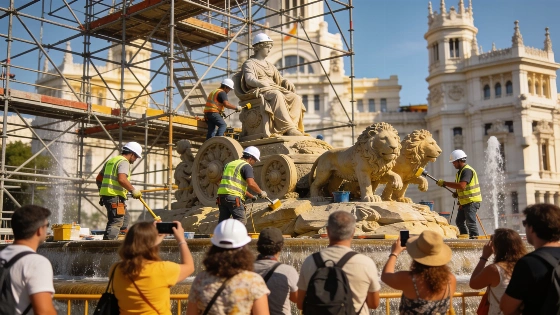
This summer, Madrid City Council is launching an unusual initiative: the public will be able to step inside the restoration works of the Fuente de Cibeles, one of the capital’s most recognisable monuments. Starting July 23, residents and visitors can reserve one of 2,640 free places for guided tours, offering a rare look at the conservation process from within the scaffolding itself.
The programme, presented by Vice Mayor Inma Sanz and Culture, Tourism and Sport Delegate Marta Rivera de la Cruz, is part of the ‘Abierto por Restauración’ series. The aim is to make the often-invisible work of heritage preservation accessible, allowing participants to see the monument’s structure, learn about the restoration criteria, and observe the techniques used to safeguard the fountain for future generations.
Guided by specialists in history and art, visitors will explore the scaffolding surrounding the Fuente de Cibeles between July and September. The tours will cover the history of the monument, the intervention methods, and the specific challenges faced by restorers. Attendees will get close views of the goddess Cibeles, her chariot, and the lions Hipómenes and Atalanta, as well as details of the sculpture and construction that are usually hidden from public view. The tours also address the main issues identified in recent studies, such as accumulated dirt, cracks, metal corrosion, and deteriorated stonework, along with the solutions being implemented.
The restoration, which began this month, is budgeted at nearly €260,000 and is expected to last five months. The project includes cleaning stone surfaces, removing unsuitable mortars, sealing joints and fissures, applying biocidal and water-repellent treatments, consolidating stone materials, restoring corroded metal elements, and improving the monument’s overall stability. Small losses will be reintegrated and the final appearance of the fountain will be harmonised.
Funding for the restoration comes from L'Oréal Groupe España, which has contributed €370,000 to Madrid’s monument conservation programme. This support covers the entire cost of the Cibeles intervention and the drafting of the project. The company previously participated in high-profile restorations, including the Notre-Dame Cathedral in Paris and Madrid’s Fuente de Neptuno. The city’s approach to public works and urban renewal has also been highlighted in other recent projects, such as the creation of new green corridors in the southeast, as detailed in Madrid’s Gran Vía del Sureste development.
The Fuente de Cibeles, designed by Ventura Rodríguez in 1777 as part of the Salón del Prado beautification plan, has stood as a symbol of Madrid for over two centuries. The central figure was sculpted by Francisco Gutiérrez Arribas, with the lions crafted by Roberto Michel. The fountain was moved to its current location in 1895 and has undergone several restorations, most recently in 1980 and 2016. Since 2021, it has been included in the UNESCO World Heritage Site Paseo del Prado and Buen Retiro, known as the Paisaje de la Luz.
In addition to the Cibeles tours, this year’s ‘Abierto por Restauración’ will feature guided visits to the Pabellón de los Hexágonos, which is also under rehabilitation. In total, the programme offers 248 guided tours and 4,800 free places, with 72 tours and 2,160 places dedicated to the pavilion.
The restoration of the Fuente de Cibeles is part of a broader effort by Madrid to preserve its historic landmarks and make cultural heritage more accessible. The city’s strategy combines technical conservation with public engagement, aiming to strengthen the connection between residents and their shared history. The inclusion of private funding and public participation reflects a growing trend in heritage management across Spain’s major cities.