Madrid's public education movement brought about 20,000 people into the streets before an indefinite strike set for 14 October 2026. Teachers, families and unions want lower workloads, smaller classes and higher pay.
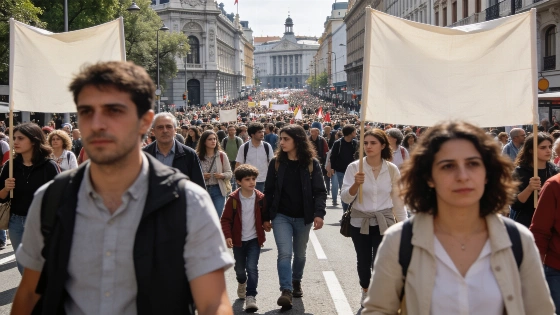
At noon on 27 September 2026, protesters left Atocha and marched towards Puerta del Sol in Madrid. The Government Delegation put the crowd at around 20,000 people. Other reports gave a range of 10,000 to 20,000. Teachers, students, families, unions and education groups took part.
The demonstration focused on workloads, class sizes, staffing and pay. It came before an indefinite strike due to start on 14 October 2026. The Community of Madrid has opened a new route towards talks, but the strike plans remain in place.
President Isabel Díaz Ayuso called for talks on a professional teaching career during the Regional Debate on 9 September. One week later, Miguel José Zurita, the regional director general for Human Resources, signed a letter calling a Sectoral Table for 22 September.
The plans remain.The union movement does not see that meeting as a replacement for action. Unions announced the indefinite strike in May and confirmed it through assemblies in June. The Unit Committee of the Public Education Strike continues to demand changes inside schools.
The 27 September march was organised with the participation of UGT, CCOO, CNT, CONFAPA Madrid, FAPA Giner de los Ríos and education platforms including Menos Lectivas.
Reports by La Razón and elDiario.es say the new negotiating channel has not led unions to withdraw the 14 October call. The dispute now turns on specific classroom demands.
The main issue is teaching time. Organisers want a maximum of 17 teaching periods per week in Secondary Education and Vocational Training. They want 22 in Primary Education. The calculation must also include tutoring, department leadership and coordination duties.
The planned action is expected to focus especially on non-university public education, including Secondary Education, Bachillerato and Vocational Training. Alongside workload limits, campaigners are calling for smaller classes, more staff to support educational diversity, less bureaucracy and improvements to school infrastructure.
Those demands concern the daily running of schools. Protesters are also calling for lower pupil-to-teacher ratios and a regularisation of teaching hours.
The march ended at Puerta del Sol. There, demonstrators joined a citizen camp calling for the right to housing.
Salary is another direct point of conflict. Aida Sanmillán, secretary general of the Madrid education federation of CCOO, said teachers had lost 21.9% of their purchasing power since 2010. She called for a €600 pay increase to secure what she described as a decent salary in the region and bring pay closer to levels in other autonomous communities.
UGT spokesperson Chema Pinto raised school segregation. He described Madrid as having the highest level in Spain and said public education must protect equal opportunities. Carlos Ochoa of the Students' Union urged working families to join the strike. He presented the dispute as a matter for the whole working class, not students alone.
Sunday's turnout gave the 14 October call a public stage beyond union offices. It also followed an earlier march over workload, class sizes and pay. The scheduled talks now face a clear test: can they address the demands before the walkout begins?
The conflict has a fixed date and measurable demands. The proposed teaching-hour limits, smaller classes, the €600 salary increase and the 21.9% loss in purchasing power set out the material basis of the protest. If the regional government's talks produce no movement, the planned strike will remain the main pressure tool for Madrid's public education sector.