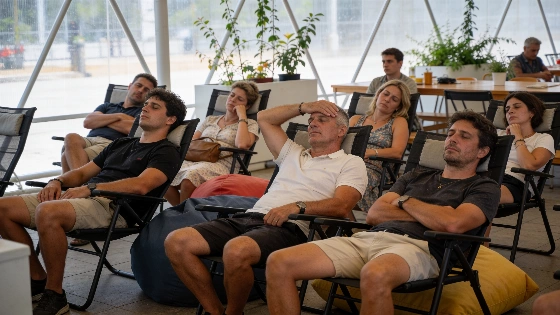
Madrid’s climate shelters are concentrated in the city center and open only for fixed periods. Experts and users say this leaves many residents unprotected during extreme heat. Calls grow for wider access and better information.
Madrid’s attempt to provide relief from extreme heat through climate shelters is facing mounting criticism. The city’s current network, limited to a handful of central locations like Círculo de Bellas Artes, CentroCentro, and Matadero Madrid, is seen as insufficient for the wider population. Both experts and users argue that these spaces fail to reach the neighborhoods most affected by high temperatures and are open only during set dates, missing some of the hottest periods.
Specialists in climate adaptation, such as Fernando Valladares from the CSIC and Ana Terra Amorim from the Basque Center for Climate Change (BC3), highlight that the shelters’ central placement caters more to tourists than to vulnerable residents in outlying districts. Valladares points out that Madrid’s urban heat island effect is among the most severe globally, making the need for accessible, well-distributed shelters urgent. He also notes that the focus on cultural activities within these spaces often overshadows their primary function: providing a cool, safe environment during heatwaves.
Residents echo these concerns. Amelia González, who works in home care and lives in Aluche, says the shelter at Círculo de Bellas Artes is more comfortable than her own home, but she questions why such facilities are not available in her neighborhood. Others, like Tamara Arranz and Fabián Jiménez, appreciate the comfort but see no need for the shelters to be “chic” or overly designed. Many users report that the spaces feel more like cultural venues than essential public infrastructure.
Another major issue is the shelters’ operating calendar. This summer, Matadero Madrid’s shelter is open only in July, CentroCentro from early July to late August, and Círculo de Bellas Artes from July to early September. Experts warn that fixed schedules are outdated, as heatwaves can strike as early as May. Amorim stresses that shelters should function as public infrastructure, not seasonal cultural programs, and should be available whenever extreme heat occurs.
Information about the shelters is also lacking. Valladares and Amorim both call for a multichannel system to inform residents about shelter locations and opening hours. Valladares suggests a dedicated app, while Amorim emphasizes the need for clear signage at bus stops, pharmacies, health centers, schools, and community associations. Some residents, like Víctor Briceño from Arganda del Rey, only discovered the shelters through their phones and note that the facilities could be cooler and more widely available.
Families from the outskirts, such as Esther Expósito’s from San Fernando de Henares, find the shelters in the city center less accessible and feel they are aimed at tourists. Expósito points out that in peripheral cities, only shopping centers offer respite from the heat, but these require consumption. Amorim suggests that private or commercial spaces could be included as shelters if they do not require purchases, reflecting a common practice among residents seeking relief in places like El Corte Inglés.
Demand for these spaces is high. On opening day, visitors like Lucy Acuña waited up to 20 minutes to enter the Círculo de Bellas Artes. Others, such as Eugenia Funes and Vicente Garri from Alicante, argue that the city council should expand the network to all neighborhoods, prioritizing public funding for shelters over other expenditures. The popularity of these spaces is evident, with some visitors, like Joaquín Álvarez, resorting to sitting on the marble floor due to crowding, and others, like Jorge Ávalos and Adrián Rodríguez, calling for the initiative to be replicated citywide.
Madrid’s approach to climate shelters stands in contrast to other recent public initiatives in Spain, such as the large-scale relocation of migrants from El Trampolín beach in Ceuta, where authorities responded to urgent needs by opening new shelters and moving over 1,800 people to safer conditions. This example, detailed in a recent report on the Ceuta operation, highlights the importance of rapid, inclusive action when public safety is at stake.
Spain’s rising summer temperatures have made the need for effective heat adaptation measures more pressing. According to the Spanish Meteorological Agency, the country has experienced a notable increase in the frequency and intensity of heatwaves over the past decade. Urban areas like Madrid are particularly vulnerable due to dense construction and limited green spaces. The World Health Organization recommends that cities develop comprehensive networks of public cooling centers, especially for at-risk populations such as the elderly, children, and those with chronic illnesses. As climate change accelerates, the debate over how to design and implement accessible, practical climate shelters in Madrid is likely to intensify, with growing pressure on local authorities to prioritize public health and equity in their response.